
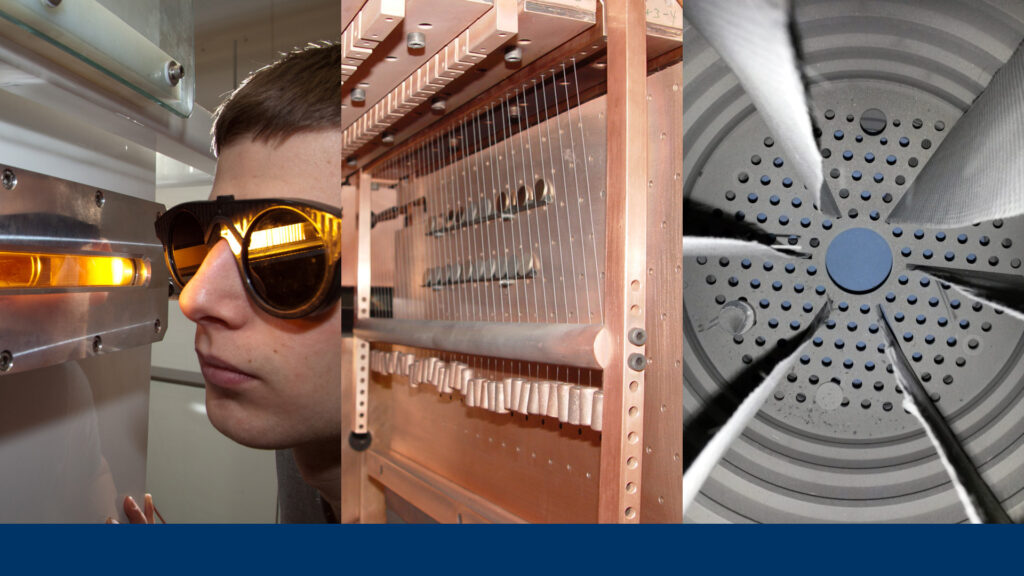
The research group “Ultra-hard coatings” investigates PVD and CVD coatings with special focus on crystalline CVD-Diamond layers. The successful research work enabled the founding of a company called DiaCCon in Fürth, Germany in 2002 (http://www.diaccon.de).
- , , , , , , :
Bioinspired damage tolerant diamond-metal laminates by alternating CVD and PVD processes
In: Materials & Design 213 (2022), Article No.: 110315
ISSN: 0264-1275
DOI: 10.1016/j.matdes.2021.110315 - , , , , :
Carbonate-Induced Electrosynthesis of Hydrogen Peroxide via Two-Electron Water Oxidation
In: Chemsuschem (2022)
ISSN: 1864-5631
DOI: 10.1002/cssc.202102137 - , , , , , , , :
Effective Hydrogen Peroxide Production from Electrochemical Water Oxidation
In: ACS Energy Letters 2021 (2021), p. 2369−2377
ISSN: 2380-8195
DOI: 10.1021/acsenergylett.1c00904 - , , , , , , , :
Avoiding Pitfalls in Comparison of Activity and Selectivity of Solid Catalysts for Electrochemical HMF Oxidation
In: ChemistryOpen 10 (2021), p. 600-606
ISSN: 2191-1363
DOI: 10.1002/open.202100072 - , , , , , :
A simple way to make tough diamond/metal laminates
In: Journal of the European Ceramic Society (2021)
ISSN: 0955-2219
DOI: 10.1016/j.jeurceramsoc.2021.03.055 - , , , :
Novel structuring technique for diamond coatings
In: Diamond and Related Materials 110 (2020)
ISSN: 0925-9635
DOI: 10.1016/j.diamond.2020.108103 - , , , , , , :
Pilot Study on the Use of a Laser-Structured Double Diamond Electrode (DDE) for Biofilm Removal from Dental Implant Surfaces
In: Journal of Clinical Medicine 9 (2020)
ISSN: 2077-0383
DOI: 10.3390/jcm9093036 - , , , , :
Catalytic electrochemical water splitting using boron doped diamond (BDD) electrodes as a promising energy resource and storage solution
In: Energies 13 (2020), Article No.: 5265
ISSN: 1996-1073
DOI: 10.3390/en13205265 - , , , , :
World's First Thermoelectric Generator Made of Tailored Carbon Allotropes
In: Advanced Engineering Materials (2020)
ISSN: 1438-1656
DOI: 10.1002/adem.202000108 - , , , , :
Boron-Doped Diamond Electrocatalyst for Enhanced Anodic H2O2 Production
In: ACS Applied Energy Materials (2020)
ISSN: 2574-0962
DOI: 10.1021/acsaem.0c00093 - , , , , , :
Electrochemical Disinfection of Dental Implants Experimentally Contaminated with Microorganisms as a Model for Periimplantitis
In: Journal of Clinical Medicine (2020)
ISSN: 2077-0383
DOI: 10.3390/jcm9020475 - , , , , :
Surface Microstructuring of Steel Components for CVD Diamond Coating by Ultrasonic Vibration Superimposed Face Milling using Tailored Tools
5th CIRP Conference on Surface Integrity, CSI 2020 (, 1. June 2020 - 5. June 2020)
In: Pedro Jose Arrazola, Aito Madariaga (ed.): Procedia CIRP 2020
DOI: 10.1016/j.procir.2020.02.020 - , , , , , :
Electrochemical Disinfection of Experimentally Infected Teeth by Boron-Doped Diamond Electrode Treatment
In: Journal of Clinical Medicine (2019)
ISSN: 2077-0383
DOI: 10.3390/jcm8122037 - , , , , , , , :
Boron-doped diamond (BDD) as an efficient back contact to thermally grown TiO2 photoelectrodes
In: ChemElectroChem (2019)
ISSN: 2196-0216
DOI: 10.1002/celc.201901073 - , , , , , :
Influence of In-Situ Electrochemical Oxidation on Implant Surface and Colonizing Microorganisms Evaluated by Scanning Electron Microscopy
In: Materials 12 (2019), Article No.: 3977
ISSN: 1996-1944
DOI: 10.3390/ma12233977 - , , , , :
Elimination of bacterial contaminations by treatment of water with boron-doped diamond electrodes
In: World Journal of Microbiology & Biotechnology 35 (2019), Article No.: 48
ISSN: 0959-3993
DOI: 10.1007/s11274-019-2624-y - , , , :
Electrochemical Degradation of Reactive Blue 19 Dye by Combining Boron-Doped Diamond and Reticulated Vitreous Carbon Electrodes
In: ChemElectroChem (2019)
ISSN: 2196-0216
DOI: 10.1002/celc.201900563 - :
Dotierung von CVD-Diamant für die n-Leitung (Dissertation, 2019) - , , , :
Influence of zirconium-based alloys on manufacturing and mechanical properties of ultra high temperature ceramic matrix composites
In: Advances in Applied Ceramics 117 (2018), p. 62-69
ISSN: 1743-6753
DOI: 10.1080/17436753.2018.1509810 - , , , , , :
Veratric acid removal from water by electrochemical oxidation on BDD anode
2nd International Conference on Advanced Materials, ICAM 2017 (Irbid, 10. July 2017 - 13. July 2017)
In: IOP Conference Series: Materials Science and Engineering Volume 305 2018
DOI: 10.1088/1757-899X/305/1/012021 - , , , , , :
Diamant auf Stahl gegen den Oberflächenverschleiß durch Aluminiumanhaftungen
In: Konstruktion (2017), p. IW8-IW9
ISSN: 0720-5953 - , , :
Long term oxidation behavior of micro- and nano-crystalline CVD diamond foils
In: Diamond and Related Materials 61 (2016), p. 41-45
ISSN: 0925-9635
DOI: 10.1016/j.diamond.2015.11.009 - , , :
Growth and thermoelectric properties of nitrogen-doped diamond/graphite
In: Diamond and Related Materials 63 (2016), p. 222-226
ISSN: 0925-9635
DOI: 10.1016/j.diamond.2015.10.023 - , , , , :
Fabrication of ultra high temperature ceramic matrix composites using a reactive melt infiltration process
In: Journal of the European Ceramic Society 36 (2016), p. 3647-3655
ISSN: 0955-2219
DOI: 10.1016/j.jeurceramsoc.2016.04.039 - , , , , , :
Fabrication and application of boron doped diamond BDD electrode in olive mill wastewater treatment in Jordan
In: Journal of Water Reuse and Desalination 7 (2016)
ISSN: 2408-9370
DOI: 10.2166/wrd.2016.062 - , , , :
Application of Electrochemical Treatment Technology of Produced Water of a Heavy Oil Field, via Boron Doped Diamond BDD Electrode
SPE Latin America and Caribbean Heavy and Extra Heavy Oil Conference (Lima, 19. October 2016 - 20. October 2016)
In: Proceedings of SPE Latin America and Caribbean Heavy and Extra Heavy Oil Conference 2016 - :
Bordotierte Diamantfolie: Herstellung und thermoelektrische Eigenschaften (Dissertation, 2016) - , , , , , :
Thermoelectric transport properties of boron-doped nanocrystalline diamond foils
In: Carbon 81 (2015), p. 650-662
ISSN: 0008-6223
DOI: 10.1016/j.carbon.2014.10.002 - , , :
Mechanical properties of micro- and nanocrystalline diamond foils
In: Philosophical Transactions of the Royal Society A-Mathematical Physical and Engineering Sciences 373 (2015), Article No.: 20140136
ISSN: 1364-503X
DOI: 10.1098/rsta.2014.0136 - , , , :
Direct measurement of Young's modulus, fracture strength and fracture toughness of nanocrystalline diamond foil by means of tensile testing
In: Acta Materialia 61 (2013), p. 7000-7008
ISSN: 1359-6454
DOI: 10.1016/j.actamat.2013.08.014 - , , , :
Surface energy of growth and seeding side of free standing nanocrystalline diamond foils
In: Surface & Coatings Technology 232 (2013), p. 640-644
ISSN: 0257-8972
DOI: 10.1016/j.surfcoat.2013.06.051 - , , , , , , :
Nano-crystalline diamond-coated titanium dental implants - A histomorphometric study in adult domestic pigs
In: Journal of Cranio-Maxillofacial Surgery 41 (2013), p. 532-538
ISSN: 1010-5182
DOI: 10.1016/j.jcms.2012.11.020 - , , , :
Adhesive bonding and brazing of nanocrystalline diamond foil onto different substrate materials
In: Applied Surface Science 282 (2013), p. 335-341
ISSN: 0169-4332
DOI: 10.1016/j.apsusc.2013.05.129 - , , , , :
Using boron doped diamond foils for fabrication of micro cavities with EDM
13th International Conference of the European Society for Precision Engineering and Nanotechnology, EUSPEN 2013
URL: https://www.scopus.com/inward/record.uri?partnerID=HzOxMe3b&scp=84908155805&origin=inward - :
Beeinflussung der Titankarbid-Schichtdicke bei der HFCDV-Diamantbeschichtung von Titan durch Oberfächenvorbehandlung und Variation der Beschichtungsparameter (Dissertation, 2013) - :
Nanokristalline Diamantfolie: Herstellung und Eigenschaften (Dissertation, 2013) - Ahmed F., Bayerlein K., Rosiwal S., Göken M., Durst K.:
Stress evolution and cracking of crystalline diamond thin films on ductile titanium substrate: Analysis by micro-Raman spectroscopy and analytical modelling
In: Acta Materialia 59 (2011), p. 5422-5433
ISSN: 1359-6454
DOI: 10.1016/j.actamat.2011.05.015 - , , , :
Self-supporting nanocrystalline diamond foils: Influence of template morphologies on the mechanical properties measured by ball on three balls testing
In: Acta Materialia 59 (2011), p. 3343-3351
ISSN: 1359-6454
DOI: 10.1016/j.actamat.2011.02.009 - , , , :
CVD-Diamond Coating as Wear Protection for Standard Heat-Treatable Steel
International Symposium on Friction, Wear and Wear Protection 2008 (Aachen)
DOI: 10.1002/9783527628513.ch30 - , , , , , , :
Using diamond coated tool-electrodes for drilling micro holes with EDM
11th International Conference of the European Society for Precision Engineering and Nanotechnology, EUSPEN 2011
URL: https://www.scopus.com/inward/record.uri?partnerID=HzOxMe3b&scp=84908255357&origin=inward - :
Eigenspannungen in Mehrschichtaufbauten aus Diamant und Chromkarbid auf Vergütungsstählen (Dissertation, 2011) - , , , :
Influence of grain size on the wear behavior of CVD diamond coatings in micro-EDM
In: International Journal of Advanced Manufacturing Technology 47 (2010), p. 919-922
ISSN: 0268-3768
DOI: 10.1007/s00170-009-2131-7 - , , :
Self-supporting nanocrystalline diamond foils - A new concept for crystalline diamond on any technical surface
In: Key Engineering Materials 438 (2010), p. 163-169
ISSN: 1013-9826
DOI: 10.4028/www.scientific.net/KEM.438.163 - , , , , :
Influence of surface roughness on the tribological properties of HF-CVD diamond coated heat-treatable steel
In: Wear 269 (2010), p. 811-815
ISSN: 0043-1648
DOI: 10.1016/j.wear.2010.08.009 - , , , :
Influence of coatings in micro-EDM
16th International Symposium on Electromachining, ISEM 2010 (Shanghai)
URL: https://www.scopus.com/inward/record.uri?partnerID=HzOxMe3b&scp=84883897735&origin=inward - :
Langzeitstabile Diamantelektroden auf Titansubstrat (Dissertation, 2010) - , , , , , :
In-situ tensile testing of crystalline diamond coatings using Raman spectroscopy
In: Surface & Coatings Technology 204 (2009), p. 1022-1025
ISSN: 0257-8972
DOI: 10.1016/j.surfcoat.2009.04.030 - , , :
Monitoring oxygen species in diamond hot-filament CVD by zircon dioxide sensors
In: Vacuum 82 (2008), p. 599-607
ISSN: 0042-207X
DOI: 10.1016/j.vacuum.2007.09.002 - , , , :
Well adherent diamond coatings on steel substrates
In: Advanced Engineering Materials 10 (2008), p. 657-660
ISSN: 1438-1656
DOI: 10.1002/adem.200800060 - :
Grundsatzuntersuchungen zum Einsatz von diamantbeschichteten Siliziumkarbid-Gleitringen im Trockenlauf (Dissertation, 2008)
Funding source: Bundesministerium für Wirtschaft und Energie (BMWE)
Project leader:

apl. Prof. Dr.-Ing. habil. Stefan Rosiwal
Professors
Contact
Der Aluminiumdruckguss ist ein effizientes und sehr weitverbreitetes Verarbeitungsverfahren. Allerdings tritt bei der Herstellung undBearbeitung von Aluminiumbauteilen ein großes Problem auf. Aluminium verbindetbzw. legiert sich bei erhöhten Temperaturen bzw. in der Schmelze mit nahezuallen Metallen. So kommt es beim Gießen von Aluminiumbauteilen häufig zuWerkzeugversagen (Ausspülungen, Risse), da die Aluminiumschmelze mit dem Eisender Stahlform bzw. mit darauf aufgebrachten Schutzschichten reag…
Funding source: Bundesministerium für Wirtschaft und Energie (BMWE)
Project leader:
apl. Prof. Dr.-Ing. habil. Stefan Rosiwal
Professors
Contact
Funding source: Deutsche Forschungsgemeinschaft (DFG)
Project leader:
apl. Prof. Dr.-Ing. habil. Stefan Rosiwal
Professors
Contact
Funding source: Deutsche Forschungsgemeinschaft (DFG)
Project leader:
apl. Prof. Dr.-Ing. habil. Stefan Rosiwal
Professors
Contact
Funding source: Bayerisches Staatsministerium für Wirtschaft und Medien, Energie und Technologie (StMWIVT) (ab 10/2013)
Acronym: DiAlum
Project leader:
apl. Prof. Dr.-Ing. habil. Stefan Rosiwal
Professors
Contact
Funding source: DFG-Einzelförderung / Sachbeihilfe (EIN-SBH)
Project leader:
apl. Prof. Dr.-Ing. habil. Stefan Rosiwal
Professors
Contact
Ziel der geplanten Arbeiten sind die Erforschung, Entwicklung und Anwendung von neuen verschleißfesten Elektrodendiamantdünnschichten für die Mikrosenkerosion. Der Vorteil solcher Diamantbeschichtungen liegt in der effizienten Mikrostrukturierung von großflächigen Elektroden mit spanenden Fertigungsverfahren wie z. B. Mikrofräsen und dem anschließenden Beschichten mit einer verschleißfesten Beschichtung, welche einen effizienten Materialabtrag während des Einsatzes ermöglicht. Durch den Einsatz…
Funding source: Bayerisches Staatsministerium für Wirtschaft, Infrastruktur, Verkehr und Technologie (StMWIVT) (bis 09/2013)
Acronym: MATSOL TP2
Project leader:
apl. Prof. Dr.-Ing. habil. Stefan Rosiwal
Professors
Contact
Das Aufgabengebiet „Innovative solarthermische Energiegewinnung“ hat sich zum Ziel gesetzt, die Kombination von Nickelbasisstrahlungsabsorbern mit thermoelektrischen Materialien zur Stromerzeugung zu untersuchen. Dabei werden in additiven Fertigungsverfahren neuartige offenzellulare Receiverstrukturen aus hochtemperaturbeständigen Superlegierungen (Nickel- und Cobaltbasis) entwickelt und getestet. Weiterhin werden p- und n-leitende Diamantstrukturen für den Bau eines effizienten Thermoelektris…
Funding source: DFG-Einzelförderung / Sachbeihilfe (EIN-SBH)
Project leader:
apl. Prof. Dr.-Ing. habil. Stefan Rosiwal
Professors
Contact
Thermoelectric generators (TEG) based on the Seebeck Effect can directly produce electrical current from the waste heat generated by cars or power plants for instance. The established TEG materials currently enable no economical use due to its toxicity, its rare availability (Bismuth- and Lead Tellurides) or its low efficiency (Silicon Germanium).Single crystalline and microcrystalline diamond have a very high thermal conductivity (ca. 2000W/mK) and a very low electrical conductivity, therefore…
Funding source: Industrie
Project leader:
apl. Prof. Dr.-Ing. habil. Stefan Rosiwal
Professors
Contact
Funding source: Industrie
Acronym: DIAHYDRO
Project leader:
apl. Prof. Dr.-Ing. habil. Stefan Rosiwal
Professors
Contact
Funding source: Bayerische Forschungsstiftung
Project leader:
apl. Prof. Dr.-Ing. habil. Stefan Rosiwal
Professors
Contact
Funding source: Bayerisches Staatsministerium für Wirtschaft, Infrastruktur, Verkehr und Technologie (StMWIVT) (bis 09/2013)
Acronym: FedDia
Project leader:
apl. Prof. Dr.-Ing. habil. Stefan Rosiwal
Professors
Contact
Funding source: BMFTR / Verbundprojekt
Project leader:
apl. Prof. Dr.-Ing. habil. Stefan Rosiwal
Professors
Contact
Funding source: Bayerische Forschungsallianz (BayFOR)
Acronym: FORLAYER TP 4 - DIAFOL
Project leader:
apl. Prof. Dr.-Ing. habil. Stefan Rosiwal
Professors
Contact
Project leader:
apl. Prof. Dr.-Ing. habil. Stefan Rosiwal
Professors
Contact
Research of hot-filament CVD technology constantly continues to provide new scientific developments that are transferred into economically functioning products. This business model enabled the establishment of the worldwide largest experimental CVD facility. Development details: Upscaling of the hot-filament diamond surface area up to 10.000cm2. Flexible chamber set up to coat small (weight < 1 g) as well as large components (weight > 40 kg) via CVD. Reduction of energy input (electric power/car…
Project leader:
apl. Prof. Dr.-Ing. habil. Stefan Rosiwal
Professors
Contact
The addition of Titanium or Vanadium during the CVD diamond coating process is expected to enable new electrical states in diamond crystal structures. The effect of alloying on the mechanical properties is also being investigated.
Current research topics:
- Evaporators for organometallic compounds with Titanium or Vanadium.
- Combination of sputtering processes with hot-filament diamond CVD.
Project leader:
apl. Prof. Dr.-Ing. habil. Stefan Rosiwal
Professors
Contact
Boron doped diamond (BDD) electrodes have a very broad application potential. This is due to the high over potential at the cathode (hydrogen formation at -1,2 V) and anodic (oxygen formation at 2.5 V) water electrolysis. This makes BDD electrodes suitable for applications, like: Efficient disinfection by killing bacteria, water treatment via direct chemical oxidation of all carbon types and cathodic reduction of CO2 in hydrocarbons. We offer different electrochemical reactors with diamond elect…
Project leader:
apl. Prof. Dr.-Ing. habil. Stefan Rosiwal
Professors
Contact
Different steels can be CVD-diamond-coated via high temperature chrome-carbide diffusion interlayers or CVD titanium-boron-nitrides. An adjusted diamond coating temperature and heat treatment is necessary to maintain the functionality (strength) of the diamond coated steel components. The research focus lies on the expansion of the spectrum of diamond coatable steels, the optimisation of necessary steel strength and strongly adherent diamond layers with a thickness higher than 10 µm. An importan…
Project leader:
apl. Prof. Dr.-Ing. habil. Stefan Rosiwal
Professors
Contact
Adherent CVD Diamond layers on hard metals are possible with titanium-boron-nitride intermediate layers. The diamond layer thickness can be higher than 100 µm. The removal of the cobalt binding phase via etching is no longer necessary, which improves the mechanical strength in the intermediate zone.
Examples:
- Piston rings and ball bearings made of hard metals
- Hard metal tools
- Hard metal erosion protection components
Project leader:
apl. Prof. Dr.-Ing. habil. Stefan Rosiwal
Professors
Contact
In 1995, we started research and development of CVD diamond coatings on silicon carbide ball bearings and piston rings.
In 2002 the know-how gained in Bavarian research projects was successfully transferred into industrial applications by the start-up of DiaCCon (Fürth, Germany).
Project leader:
apl. Prof. Dr.-Ing. habil. Stefan Rosiwal
Professors
Contact
Since Iron and Cobalt catalyse graphite formation during the CVD diamond deposition, high temperature intermediate layers are developed, which inhibit graphite forming on steel or hard metal surfaces. A special surface microstructure of the intermediate layer alloys a good mechanical adhesion with the subsequently growing diamond layer. In the temperature range from 500 °C to 1100 °C, CVD deposition of metallic Titanium or Tantalum layers and their carbides, nitrides or borides are possible. Coa…
Project leader:
apl. Prof. Dr.-Ing. habil. Stefan Rosiwal
Professors
Contact
The production of the CVD diamond layer can take place separately from the components’ surface. To achieve this, a CVD diamond coating is deposited on silicon or copper based substrates. Free-standing diamond foils with a layer thickness of 20 µm and above can be peeled off the substrate. Laser cutting allows the adequate tailoring of the diamond foils. Bonding and soldering processes are currently under research and are developed for „cold” application onto the component surface. Application ex…
Project leader:
apl. Prof. Dr.-Ing. habil. Stefan Rosiwal
Professors
Contact
Doping and varying the grain sizes via manipulation of CVD process parameters allow the production of diamond foils with application specific properties. On the one hand, micro crystalline diamond foils with a very high heat conductivity (around 2000 W/mK) and a very low electrical conductivity can be produced, while on the other hand boron doped (p-conduction) diamond foils with corresponding micro and nano grain sizes can have electrical conductivities of up to 40.000 S/m and a thermal condu…
Project leader:
apl. Prof. Dr.-Ing. habil. Stefan Rosiwal
Professors
Contact
In tribometer experiments CVD-diamond coated silicon carbide piston rings allow dry runs up to 100 km. The diamond wear in these experiments is below 3 µm. Using adjusted process parameters, a textured diamond layer in the direction can be created on the piston ring surface. Therefore, the surface is the most wear resistant when exposed to friction. The diamond coating of piston rings, which has been under investigation since 1995, is now used in industry. DiaCCon, a company founded by the chair…
Project leader:
apl. Prof. Dr.-Ing. habil. Stefan Rosiwal
Professors
Contact
The durability of diamond titanium electrodes is limited especially due to the anodic load of the electrochemical dissociation of the titanium carbide interface between diamond and titanium substrate. With the use of tantalum or niobium as more stable electrode material, the lifetime of diamond electrodes can be increased significantly. A new research effort aims to develop economic diamond electrodes, for which firstly a tantalum or titanium intermediate layer is deposited on titanium or steel…
Project leader:
apl. Prof. Dr.-Ing. habil. Stefan Rosiwal
Professors
Contact
For Aluminium high pressure die casting, different diamond coated steel tools with TiNB-intermediated layers are applied at industrial partners. The lifetime of bending tools can be increased from a few weeks to several months. Diamond coated steel sonotrodes for the ultrasonic welding of Aluminium cables are currently also being tested by industrial partners. The CVD diamond layer can permanently inhibit the reaction of the tool surface with liquid or solid Aluminium. The necessary strength of…