
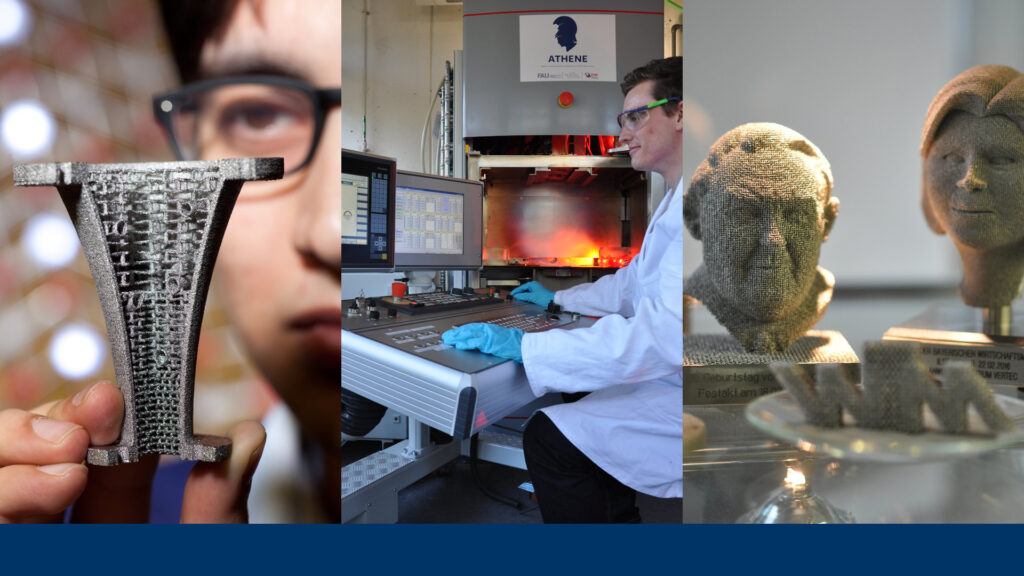
The Group Additive Manufacturing (AM) is concerned with innovative methods of powder- and beam-based AM, the further development of AM processes and the development of special AM alloys. The focus is on selective electron beam melting (SEBM), selective laser melting (SLM) and laser metal deposition (LMD).
Various Arcam electron beam machines for powder bed based additive manufacturing are available. In addition, there is a new in-house developed electron beam machine (Athene) equipped with a 6 kW electron beam gun. The vacuum-based electron beam technology allows building temperatures over 1000 ° C. These process conditions enable the processing of high performance materials such as intermetallic alloys or superalloys.
- , , , :
Detection of aluminum evaporation for TiAl using electron optical imaging in an electron beam powder bed fusion system — A feasibility study
In: Additive Manufacturing 114 (2025), Article No.: 105034
ISSN: 2214-7810
DOI: 10.1016/j.addma.2025.105034 - , , :
Single crystal twisting in additive manufacturing
In: Progress in Additive Manufacturing (2025), Article No.: 117133
ISSN: 2363-9512
DOI: 10.1007/s40964-025-01158-6 - , , , , , , :
In-situ synchrotron imaging of powder consolidation and melt pool dynamics in electron beam powder bed fusion
In: Additive Manufacturing 110 (2025), Article No.: 104943
ISSN: 2214-7810
DOI: 10.1016/j.addma.2025.104943 - , , , , , :
Spot melting sequences for complex geometries in electron beam powder bed fusion
In: Progress in Additive Manufacturing (2025)
ISSN: 2363-9512
DOI: 10.1007/s40964-025-01251-w - , , , :
Simulation-driven development of in-situ alloying Cu-25Cr by electron beam powder bed fusion
In: Additive Manufacturing 109 (2025), Article No.: 104874
ISSN: 2214-7810
DOI: 10.1016/j.addma.2025.104874 - , , , :
Three-dimensional spot melting patterns in electron beam powder bed fusion: high efficiency and tailored texture
In: Progress in Additive Manufacturing (2025)
ISSN: 2363-9512
DOI: 10.1007/s40964-025-01255-6 - , , , , :
Introduction to Powder and Beam Based Additive Manufacturing
In: Progress in Powder Based Additive Manufacturing, Cham: Springer, 2025, p. 1-11 (Springer Tracts in Additive Manufacturing, Vol.Part F386)
ISBN: 9783031783494
DOI: 10.1007/978-3-031-78350-0_1 - , , , , :
Rapid processing window development of Mo-Si-B alloy for electron beam powder bed fusion
In: Progress in Additive Manufacturing (2025)
ISSN: 2363-9512
DOI: 10.1007/s40964-025-01119-z - , , , , , , , , :
High temperature oxidation of Ni-based superalloy 247 produced by electron beam powder bed fusion additive manufacturing
In: Corrosion Science 257 (2025), Article No.: 113301
ISSN: 0010-938X
DOI: 10.1016/j.corsci.2025.113301 - , , , , , :
Mesoscopic Modeling and Simulation of Properties of Additively Manufactured Metallic Parts
In: Dietmar Drummer, Michael Schmidt (ed.): Progress in Powder Based Additive Manufacturing, Springer Nature, 2025, p. 309-330 (Springer Tracts in Additive Manufacturing, Vol.Part F386)
DOI: 10.1007/978-3-031-78350-0_15 - , , , :
Processing Strategies for Electron Beam Based Powder Bed Fusion
In: Dietmar Drummer, Michael Schmidt (ed.): Progress in Powder Based Additive Manufacturing, Springer Nature, 2025, p. 127-148 (Springer Tracts in Additive Manufacturing, Vol.Part F386)
DOI: 10.1007/978-3-031-78350-0_7 - :
Investigation of the Smoke Phenomenon in Electron Beam Powder Bed Fusion (Dissertation, 2025) - :
Impact of Beam Characteristics in Electron Beam Powder Bed Fusion (Dissertation, 2025) - :
Pulverbettbasiertes Laserstrahlschmelzen von AlSi10Mg auf einer Großanlage im Langzeitbetrieb (Dissertation, 2025) - , , , , :
Revealing the Mechanisms of Smoke during Electron Beam–Powder Bed Fusion by High-Speed Synchrotron Radiography
In: Journal of Manufacturing and Materials Processing 8 (2024), Article No.: 103
ISSN: 2504-4494
DOI: 10.3390/jmmp8030103 - , , :
Anisotropic Superelastic and Shape Memory Effect of Nitinol Manufactured by Electron Beam Powder Bed Fusion
In: Advanced Materials & Sustainable Manufacturing 1 (2024), Article No.: 10004
ISSN: 3006-2810
DOI: 10.35534/amsm.2024.10004 - , , :
Progress in electron beam additive manufacturing
In: Progress in Additive Manufacturing (2024)
ISSN: 2363-9512
DOI: 10.1007/s40964-024-00679-w - , , :
Correction to: A Scan Strategy Based Compensation of Cumulative Heating Effects in Electron Beam Powder Bed Fusion (Progress in Additive Manufacturing, (2024), 10.1007/s40964-024-00807-6)
In: Progress in Additive Manufacturing (2024)
ISSN: 2363-9512
DOI: 10.1007/s40964-024-00841-4 - , , , :
Effect of scanning strategies on grain structure and texture of additively manufactured lattice struts: A numerical exploration
In: Advanced Engineering Materials (2024)
ISSN: 1438-1656
DOI: 10.1002/adem.202400661 - , , , , , , , :
Long-term performance of PEM water electrolysis cells with 3D printed electrodes and low catalyst loading
In: International Journal of Hydrogen Energy 59 (2024), p. 480-491
ISSN: 0360-3199
DOI: 10.1016/j.ijhydene.2024.01.364 - , , :
Graph-based spot melting sequence for electron beam powder bed fusion
In: Additive Manufacturing 91 (2024), Article No.: 104321
ISSN: 2214-7810
DOI: 10.1016/j.addma.2024.104321 - , , :
Multiple interaction electron beam powder bed fusion for controlling melt pool dynamics and improving surface quality
In: Additive Manufacturing 90 (2024), Article No.: 104316
ISSN: 2214-7810
DOI: 10.1016/j.addma.2024.104316 - , , :
Correlating outgassing and smoke phenomenon in electron beam powder bed fusion of Ti6Al4V using a residual gas analyzer
In: Progress in Additive Manufacturing (2024)
ISSN: 2363-9512
DOI: 10.1007/s40964-024-00745-3 - , , , :
Thermo-Mechanical Study on Auxetic Shape Memory Periodic Open Cellular Structures—Part I: Characterization of Reentrant Geometry and Effective Heat Conductivity
In: Advanced Engineering Materials (2024)
ISSN: 1438-1656
DOI: 10.1002/adem.202401717 - , , , , :
Thermo‐mechanical Study on Auxetic Shape Memory Periodic Open Cellular Structures—Part II: Mechanical and Shape Memory Properties
In: Advanced Engineering Materials 26 (2024)
ISSN: 1438-1656
DOI: 10.1002/adem.202401310 - , , :
A Scan Strategy Based Compensation of Cumulative Heating Effects in Electron Beam Powder Bed Fusion
In: Progress in Additive Manufacturing (2024)
ISSN: 2363-9512
DOI: 10.1007/s40964-024-00807-6 - , , , :
A new approach of preheating and powder sintering in electron beam powder bed fusion
In: International Journal of Advanced Manufacturing Technology (2024)
ISSN: 0268-3768
DOI: 10.1007/s00170-024-13966-1 - , , , , :
Additive Manufacturing of TiC/Steel Composites Using Electron Beam Melting and In Situ Infiltration
In: Advanced Engineering Materials (2024)
ISSN: 1438-1656
DOI: 10.1002/adem.202301313 - , , :
Powder sintering kinetics during electron beam based additive manufacturing
In: Powder Technology 434 (2024), Article No.: 119332
ISSN: 0032-5910
DOI: 10.1016/j.powtec.2023.119332 - , , :
In situ build surface topography determination in electron beam powder bed fusion
In: Progress in Additive Manufacturing (2024)
ISSN: 2363-9512
DOI: 10.1007/s40964-024-00621-0 - , , , , , :
In-situ electron beam characterization for electron beam powder bed fusion
In: Additive Manufacturing 96 (2024), Article No.: 104567
ISSN: 2214-7810
DOI: 10.1016/j.addma.2024.104567 - , , , , , , :
Design and Characterization of a Novel NiAl–(Cr,Mo) Eutectic Alloy
In: Advanced Engineering Materials (2024)
ISSN: 1438-1656
DOI: 10.1002/adem.202302079 - , , , , :
Extracting powder bed features via electron optical images during electron beam powder bed fusion
In: Additive Manufacturing Letters 10 (2024), Article No.: 100220
ISSN: 2772-3690
DOI: 10.1016/j.addlet.2024.100220 - , , , :
Numerical Microstructure Prediction for Lattice Structures Manufactured by Electron Beam Powder Bed Fusion
In: Crystals 14 (2024), Article No.: 149
ISSN: 2073-4352
DOI: 10.3390/cryst14020149 - , , :
Comprehensive numerical investigation of laser powder bed fusion process conditions for bulk metallic glasses
In: Additive Manufacturing 81 (2024), Article No.: 104026
ISSN: 2214-7810
DOI: 10.1016/j.addma.2024.104026 - , , , , , , :
Accelerating Alloy Development for Additive Manufacturing
15th International Symposium on Superalloys, ISS 2024 (Pennsylvania, PA, 8. September 2024 - 12. September 2024)
In: Jonathan Cormier, Ian Edmonds, Stephane Forsik, Paraskevas Kontis, Corey O’Connell, Timothy Smith, Akane Suzuki, Sammy Tin, Jian Zhang (ed.): Minerals, Metals and Materials Series 2024
DOI: 10.1007/978-3-031-63937-1_11 - :
Modeling and Simulation of Bulk Metallic Glass Crystallization During Laser Powder Bed Fusion (Dissertation, 2024)
DOI: 10.25593/open-fau-715 - :
Elektronenstrahlbasierte additive Fertigung von Titanaluminid-Bauteilen mit dualer Mikrostruktur (Dissertation, 2024) - :
Electron beam-based additive manufacturing of Fe-Si soft magnetic materials (Dissertation, 2024) - , , , , :
Correlation Between Structural Features and Magnetic Performance of Fe93.5Si6.5 (wt.%) Soft Magnetic Materials
In: Advanced Functional Materials (2023)
ISSN: 1616-301X
DOI: 10.1002/adfm.202308194 - , , , , :
Microstructure and mechanical properties of additively manufactured γ-TiAl with dual microstructure
In: Intermetallics 161 (2023), Article No.: 107978
ISSN: 0966-9795
DOI: 10.1016/j.intermet.2023.107978 - , , :
Robust γ-TiAl Dual Microstructure Concept by Advanced Electron Beam Powder Bed Fusion Technology
In: Crystals 13 (2023), Article No.: 1348
ISSN: 2073-4352
DOI: 10.3390/cryst13091348 - , , :
A return time compensation scheme for complex geometries in electron beam powder bed fusion
In: Additive Manufacturing 76 (2023), p. 103767
ISSN: 2214-7810
DOI: 10.1016/j.addma.2023.103767 - , , :
A Thermo-Mechanical Model for Hot Cracking Susceptibility in Electron Beam Powder Bed Fusion of Ni-Base Superalloys
In: Materials & Design 237 (2023), p. 112528
ISSN: 0264-1275
DOI: 10.1016/j.matdes.2023.112528 - , , , , , , , , , , , , , , , , :
MiniMelt: An instrument for real-time tracking of electron beam additive manufacturing using synchrotron x-ray techniques
In: Review of Scientific Instruments 94 (2023)
ISSN: 0034-6748
DOI: 10.1063/5.0177255 - , , :
Impact of the acceleration voltage on the processing of γ-TiAl via electron beam powder bed fusion
In: Progress in Additive Manufacturing (2023)
ISSN: 2363-9512
DOI: 10.1007/s40964-023-00499-4 - , , :
Functional properties and shape memory effect of Nitinol manufactured via electron beam powder bed fusion
In: Materialia 30 (2023), Article No.: 101823
ISSN: 2589-1529
DOI: 10.1016/j.mtla.2023.101823 - , , , :
Electron-optical observation of smoke evolution during electron beam powder bed fusion
In: Additive Manufacturing 70 (2023), Article No.: 103578
ISSN: 2214-7810
DOI: 10.1016/j.addma.2023.103578 - , , , , , , :
Revealing bulk metallic glass crystallization kinetics during laser powder bed fusion by a combination of experimental and numerical methods
In: Journal of Non-Crystalline Solids 619 (2023), Article No.: 122532
ISSN: 0022-3093
DOI: 10.1016/j.jnoncrysol.2023.122532 - , , , :
A Ray Tracing Model for Electron Optical Imaging in Electron Beam Powder Bed Fusion
In: Journal of Manufacturing and Materials Processing 7 (2023), Article No.: 87
ISSN: 2504-4494
DOI: 10.3390/jmmp7030087
Funding source: Bundesministerium für Forschung, Technologie und Raumfahrt (BMFTR)
Project leader:
Prof. Dr.-Ing. habil. Carolin Körner
Chair of Materials Science and Engineering for Metals
Contact
Funding source: DFG / Sonderforschungsbereich / Transregio (SFB / TRR)
Project leader: ,
Prof. Dr.-Ing. habil. Carolin Körner
Chair of Materials Science and Engineering for Metals
Contact

Dr.-Ing. Matthias Markl
Chair of Materials Science and Engineering for Metals
Contact
Project B2 explores selective electron beam melting, which belongs to the additive manufacturing technologies, for the processing of single-crystalline superalloys. Especially the potential of the inherent high cooling rates is investigated. These lead to an ultra-fine and directional solidified microstructure. The main challenge of this project is to develop innovative processing strategies based on a sound theoretical process understanding in order to produce crack-free and preferably single crystalline samples, also with higher geometric complexity.
Funding source: DFG-Einzelförderung / Sachbeihilfe (EIN-SBH)
Project leader: ,
Prof. Dr.-Ing. habil. Carolin Körner
Chair of Materials Science and Engineering for Metals
Contact
Cellular structures represent a promising alternative to classical randomly packed bed reactors owing to their very good heat transport characteristics. A key challenge of using cellular structures as catalyst carriers in tubular reactors is the contact of the structure with the tube wall, which in many cases is not sufficient and thus downgrades the overall heat transfer performance. Especially with strongly exo- or endothermic reactions, this inhibition of heat transfer leads to undesirable temperature…
Funding source: Bundesministerium für Wirtschaft und Energie (BMWE)
Project leader:
Prof. Dr.-Ing. habil. Carolin Körner
Chair of Materials Science and Engineering for Metals
Contact
Funding source: DFG / Sonderforschungsbereich (SFB)
Project leader: ,
Prof. Dr.-Ing. habil. Carolin Körner
Chair of Materials Science and Engineering for Metals
Contact
Dr.-Ing. Matthias Markl
Chair of Materials Science and Engineering for Metals
Contact
The aim of this project is to facilitate additive manufacturing of bulk metallic components by selective laser melting based on predictive numerical simulations. There should be developed suitable process strategies to ensure the amorphous material state preferably without aging effects in the bulk as well as for complex geometries. Therefore, clear statements using the numerical simulation has to be made exceeding the temperature field and the material consolidation during manufacturing towards the solidification behavior, aging and finally crystallization.
Funding source: DFG / Sonderforschungsbereich (SFB)
Project leader: ,
Prof. Dr.-Ing. habil. Carolin Körner
Chair of Materials Science and Engineering for Metals
Contact
Dr.-Ing. Matthias Markl
Chair of Materials Science and Engineering for Metals
Contact
This sub-project aims to automate the development of process strategies for selective electron beam melting. The integration of the innovative electron optics in the process cycle allows an in situ quality control and in combination with the findings from the first funding periods, the active control of the process. Finally, a self-learning system should be able to manufacture arbitrary parts of even novel alloys by a process database optimization.
Funding source: BMFTR / Verbundprojekt
Project leader: ,
Prof. Dr.-Ing. habil. Carolin Körner
Chair of Materials Science and Engineering for Metals
Contact
Funding source: EU - 8. Rahmenprogramm - Horizon 2020
Project leader:
Prof. Dr.-Ing. habil. Carolin Körner
Chair of Materials Science and Engineering for Metals
Contact
Funding source: DFG-Einzelförderung / Sachbeihilfe (EIN-SBH)
Project leader:
Prof. Dr.-Ing. habil. Carolin Körner
Chair of Materials Science and Engineering for Metals
Contact
Funding source: DFG / Sonderforschungsbereich (SFB)
Project leader:
Prof. Dr.-Ing. habil. Carolin Körner
Chair of Materials Science and Engineering for Metals
Contact
The basic mechanisms that are essential in the powder based selective beam melting process are poorly understood. Most of the existing analytical and numerical models describing the process of consolidation in a homogenized image, i.e. individual powder particles are not resolved. This approach is suitable for information on averages, but cannot capture the local influence of the powder, i.e. the powder size distribution, the stochastic effect of the powder bed, the wetting of the powder by the melt and the formation of the melt. The actual selective melting process and thereby acting mechanisms can only be understood on the scale of the powder particles, with the help of numerical simulation on the mesoscopic scale. The aim of this project is to provide a numerical tool for mesoscopic simulation of selective beam melting and to use it to develop innovative process strategies. The mesoscopic scale allows the prediction of defects, surface quality and accuracy of the structure for different materials as a function of material parameters (powder form, bulk density, ...) and the process parameters (beam shape, energy per unit length, speed, ...).
In the first phase, a tool for the 2D simulation of selective electron beam melting was developed and validated with experimental results. The main task was the modeling of the entire build process with its different time scales (pre-heating, melting, applying new powder layer). Among other things, the complex coupling of the beam in the powder bed, radiation losses at the surface, mass and energy loss through evaporation and the deformation of the molten bath by the evaporation pressure is taken into account. The software is now able to simulate assembly processes, taking into account different scanning strategies on many layers. Such process strategies as the remelt strategy and the refill strategy are investigated. The verification of the numerical results is done in close cooperation with subproject B2.
In the second phase, the previous model is transferred to polymers. For this purpose, the absorption of the laser beam in the partially transparent stochastic powder bed and the highly viscous, viscoelastic material behavior must be described. Development and verification of the model is carried out in cooperation with subproject B3. In a further step, a method of 3D simulation of the grain structure in the selective beam melting of metals is implemented, in order to predict the texture of the materials as a function of process strategy.
Funding source: DFG / Sonderforschungsbereich (SFB)
Project leader: ,
Fundamental understanding of a new and innovative process combining sheet metal forming with additive manufacturing is the main goal of this research work.
Funding source: andere Förderorganisation
Project leader:
Prof. Dr.-Ing. habil. Carolin Körner
Chair of Materials Science and Engineering for Metals
Contact
Funding source: Bundesministerium für Wirtschaft und Energie (BMWE)
Project leader:
Prof. Dr.-Ing. habil. Carolin Körner
Chair of Materials Science and Engineering for Metals
Contact
Funding source: andere Förderorganisation
Project leader:
Prof. Dr.-Ing. habil. Carolin Körner
Chair of Materials Science and Engineering for Metals
Contact
Project leader:
Prof. Dr.-Ing. habil. Carolin Körner
Chair of Materials Science and Engineering for Metals
Contact
Funding source: Industrie
Project leader:
Prof. Dr.-Ing. habil. Carolin Körner
Chair of Materials Science and Engineering for Metals
Contact
Funding source: DFG-Einzelförderung / Sachbeihilfe (EIN-SBH)
Project leader: ,
Prof. Dr.-Ing. habil. Carolin Körner
Chair of Materials Science and Engineering for Metals
Contact
Raney-copper is a catalyst made from a copper base alloy containing at least one less noble element than copper (e.g. zinc). After fabricating the base material via a casting process consisting of a melt and a quenching step the alloy can be converted into a nanoporous and catalytically active structure using an alkaline solution.
During this project a Raney-copper type alloy will be processed using the selective electron beam melting process (SEBM). The main goal of this project is to utilize the process’ specific characteristics like a high cooling rate and geometric freedom to build periodic cellular catalyst structures. Those cellular structures surface will then be made catalytically active for their application in the methanol synthesis process using a leaching step. In contrast to other yet fabricated cellular metal catalyst structures the Raney-copper ones do not need any further coating with active species like e.g. palladium.
Funding source: andere Förderorganisation
Project leader: ,
Prof. Dr.-Ing. habil. Carolin Körner
Chair of Materials Science and Engineering for Metals
Contact
Ziel dieses Projektes ist es, die Einschränkungen der bisherigen Elektronenstrahlkanone und eingeschränkten Prozesskontrolle zu überwinden, um damit einen großen Entwicklungsschritt in dieser Technologie zu vollziehen. Dazu ist geplant, die Elektronenstrahlkanone einer bei WTM vorhandenen Arcam S12 (diese wird geopfert) durch eine erheblich leistungsfähigere Elektronenstrahlkanone zu ersetzen. Auf dem Markt sind Kanonen mit sehr viel höherer Leistung bei gleichbleibend guter Strahlqualität vorhan…
Funding source: Siemens AG
Project leader:
Prof. Dr.-Ing. habil. Carolin Körner
Chair of Materials Science and Engineering for Metals
Contact
Funding source: DFG / Exzellenzcluster (EXC)
Project leader:
Prof. Dr.-Ing. habil. Carolin Körner
Chair of Materials Science and Engineering for Metals
Contact
Metamaterials are artificial structures with extraordinary properties as result of their internal architecture. We are investigating mechanical metamaterials manufactured by SEBM. We investigate auxetic materials characterized by a negative Poisson’s ratio as well as phononic band gap materials. Structure design rests upon basic knowledge about mechanisms generated by numerical simulation.
Funding source: DFG-Einzelförderung / Sachbeihilfe (EIN-SBH)
Project leader:
Prof. Dr.-Ing. habil. Carolin Körner
Chair of Materials Science and Engineering for Metals
Contact
Additive manufacturing of components is a key technology of the future. The powder bed based selective electron beam melting process allows to produce complex components from high performance alloys. Nevertheless, the highly dynamic melting process is not fully understood and suffers from binding faults, changes of the alloy composition and process instabilities. Aim of the project is to understand the basic mechanisms during selective electron beam melting and to use this knowledge to predict and to influence the resulting materials quality. In order to reach this aim, the selevtive electron beam melting process takting selective vaporation phenomena into account is simulated based on a Lattice Boltzmann Model. Evaporation leads to material loss, has influence on the melt pool dynamics and changes the alloy composition. Simulation on the scale of the powder particles reveals phenomena which result from the complex interplay between beam, powder and melt pool. The numerical results are varified by experiments by an exemplary alloy.
Funding source: DFG / Exzellenzcluster (EXC)
Project leader:
Prof. Dr.-Ing. habil. Carolin Körner
Chair of Materials Science and Engineering for Metals
Contact
Target oriented material development has to be based on a profound understanding of process-inherent mechanisms. This project aims on in-situ observation of the material consolidation process during additive manufacturing.
This includes particular phase transformations and the nucleation and growth of precipitates. The observation of these phenomena is a big challenge due to their high temporal dynamics. New experimental environments allow the observation of the formation of the microstructure of a material under AM conditions. Access to this accelerator based experimental environment allows the competence anchor DESY-FAU DHW, a cooperation between FAU and the Helmholtz centers DESY and DHW.
Funding source: EU - 7. RP / Cooperation / Verbundprojekt (CP)
Project leader:
Prof. Dr.-Ing. habil. Carolin Körner
Chair of Materials Science and Engineering for Metals
Contact
The overarching goal of AMAZE is to rapidly produce large defect-free additively-manufactured (AM) metallic components up to 2 metres in size, ideally with close to zero waste, for use in the following high-tech sectors namely: aeronautics, space, automotive, nuclear fusion and tooling.
Four pilot-scale industrial AM factories will be established and enhanced, thereby giving EU manufacturers and end-users a world-dominant position with respect to AM production of high-value metallic parts, by 2016. A further aim is to achieve 50% cost reduction for finished parts, compared to traditional processing.
The project will design, demonstrate and deliver a modular streamlined work-flow at factory level, offering maximum processing flexibility during AM, a major reduction in non-added-value delays, as well as a 50% reduction in shop-floor space compared with conventional factories.
AMAZE will dramatically increase the commercial use of adaptronics, in-situ sensing, process feedback, novel post-processing and clean-rooms in AM, so that (i) overall quality levels are improved, (ii) dimensional accuracy is increased by 25% (iii) build rates are increased by a factor of 10, and (iv) industrial scrap rates are slashed to <5%. Scientifically, the critical links between alloy composition, powder/wire production, additive processing, microstructural evolution, defect formation and the final properties of metallic AM parts will be examined and understood. This knowledge will be used to validate multi-level process models that can predict AM processes, part quality and performance. In order to turn additive manufacturing into a mainstream industrial process, a sharp focus will also be drawn on pre-normative work, standardisation and certification, in collaboration with ISO, ASTM and ECSS. The team comprises 31 partners: 21 from industry, 8 from academia and 2 from intergovernmental agencies. This represent the largest and most ambitious team ever assembled on this topic.
Funding source: EU - 7. RP / Capacities / Forschung für spezielle Gruppen (insbesondere KMU) (SME)
Project leader:
Prof. Dr.-Ing. habil. Carolin Körner
Chair of Materials Science and Engineering for Metals
Contact
Electron beam melting additive manufacturing is used to produce successive layers of a part in a powder bed and offers the ability to produce components closest to their final dimensions, with good surface finish. At this time the process is faster than any other technique of comparable quality, however the parts are not produced at sufficient rate to make them economically viable for any but very high value specific applications. One key output of the project will be the knowledge surrounding the use of the high powder electron beam gun, including the process control, and modeled and validated understanding of beam-powder bed interaction. The target objectives is the transfer of the 2D model to a 3D model and its parallel implementation. The outcome of the simulation will be compared with real experimental data and therefore the model parameters are adjusted in such a way that the resulting numerical melt pool sizes correspond to the experimental ones.
Funding source: Sonstige EU-Programme (z. B. RFCS, DG Health, IMI, Artemis)
Project leader:
Prof. Dr.-Ing. habil. Carolin Körner
Chair of Materials Science and Engineering for Metals
Contact
Funding source: DFG-Einzelförderung / Sachbeihilfe (EIN-SBH)
Project leader:
Titanaluminde haben durch das Ersetzen deutlich schwererer Nickelbasislegierungen großes Potential für Kraftstoffeinsparungen in zukünftige Generationen von Flugzeug- und Kraftwerksturbinen. Die Verarbeitung dieser Materialien gestaltet sich allerdings äußerst schwierig, da die Materialeigenschaften stark von der Mikrostruktur und chemischen Homogenität des Endproduktes abhängen. Im vorliegenden Vorhaben soll ein Rapid Manufacturing Prozess, das selektive Elektronenstrahlschmelzen, zur Verarb…
Project leader:
Prof. Dr.-Ing. habil. Carolin Körner
Chair of Materials Science and Engineering for Metals
Contact
The electron beam offers the potential for innovative selective beam melting process strategies due its inertia-free deflection at extremely high speed.
A deep understanding of the process is developed with the help of different methods of in-situ process monitoring (thermal imaging and high speed camera). In particular, the potential to tailor the microstructure, grain structure and texture of the material with the help of the extremely high beam velocity is explored. In addition, we investigate the mechanisms of evaporation induced material displacement and the possibility to use this effect to realize hollow structures within components.
CRC DFG 814 “Additive Manufacturing” (http://www.sfb814.forschung.uni-erlangen.de/).
A further focus is on processing of single crystalline nickel-base alloys. We are designing building strategies to avoid cold and hot crack formation. The main challenge is to control directional and rapid solidification in order to realize single crystals directly developing from powder particles without any seed material. We are now able to realize large single crystals out of nickel-base alloys with unique homogeneity by selective electron beam melting.
CRC DFG TR 103 “From Atom to Turbine Blade” (http://www.sfb-transregio103.de/).
Project leader:
Prof. Dr.-Ing. habil. Carolin Körner
Chair of Materials Science and Engineering for Metals
Contact
We investigate the potential of SEBM for processing of technical alloys based on Iron Aluminides, Nickel and Copper as well as amorphous metals.
For Iron aluminides, the focus is on the influence of additional elements such as Boron and Titanium on the workability, the microstructure and the resulting properties.
Concerning pure Copper and Copper alloys our focus is on the influence of minor elements or contaminations such as Oxygen or Phosphorus on the resulting properties, in particular the achievable heat conductivity
Project leader:
Prof. Dr.-Ing. habil. Carolin Körner
Chair of Materials Science and Engineering for Metals
Contact
Commercial available EBSM machines show strong limitations with respect to the beam power, beam quality and beam control. To overcome these limitations, the electron gun and control system of an Arcam S12 System was renewed. The resulting machine is equipped with a 6 kW electron beam gun and a backscattering electron detector for process monitoring. This is the first electron beam AM machine where the electron beam serves for both, processing and analyzing.
Project leader:
Prof. Dr.-Ing. habil. Carolin Körner
Chair of Materials Science and Engineering for Metals
Contact
We investigate new alloys for structural catalysts that serve as carrier material and simultaneously as catalytically active material in structured reactors. The active catalyst (Raney copper type) develops from the AM manufactured structure by leaching. Thus, geometric restrictions of complex coating processes for catalytic functionalization disappear. The direct generation of the catalytically active material on the carrier structure is expected to show advantages with respect to thermal management. In order to demonstrate the potential of structural catalysts we consider the methanol synthesis.
Project leader:
Prof. Dr.-Ing. habil. Carolin Körner
Chair of Materials Science and Engineering for Metals
Contact
We use combinatorial methods for the development of new alloys that allow the creation of large material libraries based on thermodynamic predictions. To do this, the Chair of WTM is currently establishing a laser metal deposition machine from the company InssTek. This machine is equipped with four powder hoppers in a glove box with inert gas atmosphere. Besides materials libraries we are also able to realize multi-material and graded components.
Project leader:
Prof. Dr.-Ing. habil. Carolin Körner
Chair of Materials Science and Engineering for Metals
Contact
Target oriented material development has to be based on a profound understanding of process-inherent mechanisms. This project aims on in-situ observation of the material consolidation process during additive manufacturing.
This includes particular phase transformations and the nucleation and growth of precipitates. The observation of these phenomena is a big challenge due to their high temporal dynamics. New experimental environments allow the observation of the formation of the microstructure of a material under AM conditions. Access to this accelerator based experimental environment allows the competence anchor DESY-FAU DHW, a cooperation between FAU and the Helmholtz centers DESY and DHW.
Project leader:
Prof. Dr.-Ing. habil. Carolin Körner
Chair of Materials Science and Engineering for Metals
Contact
We examine the possibility to process high performance alloys such as non-weldable Nickel-base alloys or special Copper alloys by means of SEBM. There are also experiences in the processing of Titanium alloys, in particular for medical applications, Titanium aluminides and steels.
Funding source: Industrie
Project leader:
Prof. Dr.-Ing. habil. Carolin Körner
Chair of Materials Science and Engineering for Metals
Contact
Funding source: DFG - Sonderforschungsbereiche
Project leader: ,
Prof. Dr.-Ing. habil. Carolin Körner
Chair of Materials Science and Engineering for Metals
Contact
Based on the gained knowledge of projects B4 and C5, the aim of this project is to account for the influence of part borders on the resulting material/part-mesostructure for powder- and beam-based additive manufacturing technologies of metals and to model the resulting meso- and macroscopic mechanical properties. The mechanical behavior of these mesostructures and the influence of the inevitable process-based geometrical uncertainties is modelled, verified, quantified and validated especially for cellular grid-based structures.