
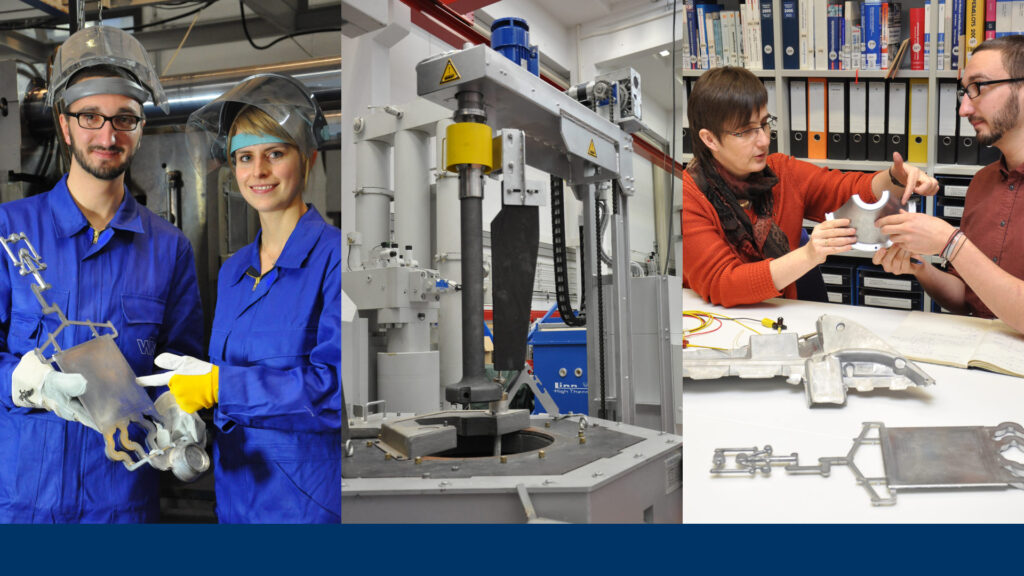
Our research focuses on both innovative process technology and material development.
- :
Steifigkeitserhöhung von Aluminium-Druckgusslegierungen durch in-situ gebildete Al3Ti-Partikel - Prozesstechnologie und Charakterisierung (Dissertation, 2023) - , , :
In-situ Al3Ti particle reinforcement for stiff aluminum die castings
In: Journal of Alloys and Compounds (2022), Article No.: 163984
ISSN: 0925-8388
DOI: 10.1016/j.jallcom.2022.163984 - , , , :
Fluidization behavior of graphitized glassy particles in a fluidized carbon bed cooling process for investment casting
In: Particuology 65 (2022), p. 32-38
ISSN: 1674-2001
DOI: 10.1016/j.partic.2021.07.001 - :
Mikrozellulare Aluminiumintegralschäume (Dissertation, 2022) - , , :
Heat treatment of high-pressure die casting Al-Mg-Si-Mn-Zn alloys
In: Journal of Alloys and Compounds (2021)
ISSN: 0925-8388
DOI: 10.1016/j.jallcom.2021.159692 - , , , , , , , :
Improving the Effectiveness of the Solid-Solution-Strengthening Elements Mo, Re, Ru and W in Single-Crystalline Nickel-Based Superalloys
In: Metals 11 (2021), Article No.: 1707
ISSN: 2075-4701
DOI: 10.3390/met11111707 - :
Halbautomatische Herstellung und Eigenschaften von in situ Al3Ti-verstärkten Aluminiumgusslegierungen im Druckgießen
In: Giesserei 02/2021 (2021), p. 61
ISSN: 0016-9765 - , , , , , , :
Thermoelastic properties and γ’-solvus temperatures of single-crystal Ni-base superalloys
In: Journal of Materials Science (2021)
ISSN: 0022-2461
DOI: 10.1007/s10853-020-05628-w - :
Bedeutung der Mischkristallhärter für die Kriechbeständigkeit Re-freier Nickelbasis-Einkristall-Legierungen (Dissertation, 2021) - :
Verbesserung der Kriechbeständigkeit der pulverspritzgegossenen Nickelbasis-Legierung CM247LC durch Legierungsentwicklung und Wärmebehandlung (Dissertation, 2021) - , , :
Formation kinetics and phase stability of in-situ Al3Ti particles in aluminium casting alloys with varying Si content
In: Results in Materials (2020)
ISSN: 2590-048X
DOI: 10.1016/j.rinma.2020.100103 - , , , , :
Heat treatment of the new high-strength high-ductility Al–Mg–Si–Mn alloys with Sc, Zr and Cr additions
In: Materialia 15 (2020), Article No.: 100981
ISSN: 2589-1529
DOI: 10.1016/j.mtla.2020.100981 - , , , :
Processing of in situ Al3Ti/Al composites by advanced high shear technology: influence of mixing speed
In: International Journal of Advanced Manufacturing Technology 110 (2020), p. 1589-1599
ISSN: 0268-3768
DOI: 10.1007/s00170-020-05956-w - , , , , , , , , , :
Exploring the fundamentals of Ni-based superalloy single crystal (SX) alloy design: Chemical composition vs. microstructure
In: Materials & Design 195 (2020), Article No.: 108976
ISSN: 0264-1275
DOI: 10.1016/j.matdes.2020.108976 - , , , , :
Multi-alloying effect of Sc, Zr, Cr on the Al-Mg-Si-Mn high-pressure die casting alloys
In: Materials Characterization 168 (2020)
ISSN: 1044-5803
DOI: 10.1016/j.matchar.2020.110537 - , , , :
Morphology and Nucleation of Intermetallic Phases in Casting Al–Mg–Si Alloys
In: Metallography, Microstructure, and Analysis (2020)
ISSN: 2192-9262
DOI: 10.1007/s13632-020-00702-w - :
Studying the Structure of Al–Mg–Si Casting Alloys Doped by Lithium
In: Physics of Metals and Metallography 121 (2020), p. 701-707
ISSN: 0031-918X
DOI: 10.1134/S0031918X2007011X - , , , :
Structure formation and multistep nucleation in Casting Al-Mg-Si alloys
In: International Journal of Cast Metals Research (2020)
ISSN: 1364-0461
DOI: 10.1080/13640461.2020.1822632 - , , , , :
Impact of the Co/Ni-Ratio on Microstructure, Thermophysical Properties and Creep Performance of Multi-Component γ′-Strengthened Superalloys
In: Crystals 10 (2020), p. 1058
ISSN: 2073-4352
DOI: 10.3390/cryst10111058 - , , , , , , , :
The Effect of Alloying on the Thermophysical and Mechanical Properties of Co–Ti–Cr-Based Superalloys
DOI: 10.1007/978-3-030-51834-9_89 - , , , , , , , , , , :
On the Influence of Alloy Composition on Creep Behavior of Ni-Based Single-Crystal Superalloys (SXs)
14th International Symposium on Superalloys, Superalloys 2021 (Seven Springs, PA, 12. September 2021 - 16. September 2021)
In: Sammy Tin, Mark Hardy, Justin Clews, Jonathan Cormier, Qiang Feng, John Marcin, Chris O'Brien, Akane Suzuki (ed.): Minerals, Metals and Materials Series 2020
DOI: 10.1007/978-3-030-51834-9_6 - , , , , , :
Castability and Recrystallization Behavior of γ′-Strengthened Co-Base Superalloys
DOI: 10.1007/978-3-030-51834-9_88 - :
Entwicklung eines wirbelbettbasierten Feingussverfahrens zur Verbesserung der Erstarrungsmikrostruktur von gerichtet erstarrten Superlegierungsbauteilen (Dissertation, 2020) - :
Design of Al-Mg-Si-Mn alloys with Zn, Cr and Sc additions with unique strengthening response (Dissertation, 2020) - , , , :
In situ Al3Ti/Al composites fabricated by high shear technology: microstructure and mechanical properties
In: Materials Science and Technology 35 (2019), p. 2294-2303
ISSN: 0267-0836
DOI: 10.1080/02670836.2019.1677025 - , , , :
Improvement of the high-pressure die casting alloy Al-5.7Mg-2.6Si-0.7Mn with Zn addition
In: Materials Characterization 158 (2019)
ISSN: 1044-5803
DOI: 10.1016/j.matchar.2019.109959 - , , , , :
Creep properties of single crystal Ni-base superalloys (SX): A comparison between conventionally cast and additive manufactured CMSX-4 materials
In: Materials Science and Engineering A-Structural Materials Properties Microstructure and Processing 762 (2019), Article No.: 138098
ISSN: 0921-5093
DOI: 10.1016/j.msea.2019.138098 - , , , , :
Effect of Zr, Cr and Sc on the Al–Mg–Si–Mn high-pressure die casting alloys
In: Materials Science and Engineering A-Structural Materials Properties Microstructure and Processing (2019)
ISSN: 0921-5093
DOI: 10.1016/j.msea.2019.05.038 - , :
Sensor-based Observation and Numerical Simulation of Mold Filling During High Pressure Die Casting
In: Giesserei (2019), p. 18-25
ISSN: 0016-9765 - , , , , , , , :
MultOpt++: a fast regression-based model for the development of compositions with high robustness against scatter of element concentrations
In: Modelling and Simulation in Materials Science and Engineering 27 (2019)
ISSN: 0965-0393
DOI: 10.1088/1361-651X/aaf0b8 - , , , , , , :
MultOpt++: a fast regression-based model for the constraint violation fraction due to composition uncertainties
In: Modelling and Simulation in Materials Science and Engineering 27 (2019)
ISSN: 0965-0393
DOI: 10.1088/1361-651X/aaf01e - , :
Multistep nucleation and multi-modification effect of Sc in hypoeutectic Al-Mg-Si alloys
In: Heliyon 5 (2019)
ISSN: 2405-8440
DOI: 10.1016/j.heliyon.2019.e01202 - , , :
Metal injection molding (MIM) of nickel-base superalloys
In: Donald F. Heaney (ed.): Handbook of Metal Injection Molding (2nd edition), 2019, p. 575-608 (Woodhead Publishing Series in Metals and Surface Engineering)
DOI: 10.1016/B978-0-08-102152-1.00028-3 - :
In-situ Al3Ti/Al composites produced by high shear technology: microstructure and mechanical properties (Dissertation, 2019) - , , , :
Microstructures and Mechanical Properties of Al3Ti/Al Composites Produced In Situ by High Shearing Technology
In: Advanced Engineering Materials (2018)
ISSN: 1438-1656
DOI: 10.1002/adem.201800259 - , , , , :
Oxidation Behavior of Superalloy IN 713 Fabricated by Metal Injection Molding
In: Oxidation of Metals (2018)
ISSN: 0030-770X
DOI: 10.1007/s11085-018-9869-y - , , , , :
High-Volume Production-Compatible Technologies for Light Metal and Fiber Composite-Based Components with Integrated Piezoceramic Sensors and Actuators
In: Advanced Engineering Materials 20 (2018), Article No.: 1801001
ISSN: 1438-1656
DOI: 10.1002/adem.201801001 - , , , , , , , , , , , , , , , , :
Development of Single-Crystal Ni-Base Superalloys Based on Multi-criteria Numerical Optimization and Efficient Use of Refractory Elements
In: Metallurgical and Materials Transactions A-Physical Metallurgy and Materials Science 49A (2018), p. 4134-4145
ISSN: 1073-5623
DOI: 10.1007/s11661-018-4759-0 - , , , :
Optimization of Mechanical Properties of Al–Al‐Compound Castings by Adapted Heat Treatment
In: Advanced Engineering Materials (2018)
ISSN: 1438-1656
DOI: 10.1002/adem.201800400 - , , , , , , , :
Effects of Solid Solution Strengthening Elements Mo, Re, Ru, and W on Transition Temperatures in Nickel-Based Superalloys with High γ′-Volume Fraction: Comparison of Experiment and CALPHAD Calculations
In: Metallurgical and Materials Transactions A-Physical Metallurgy and Materials Science (2018)
ISSN: 1073-5623
DOI: 10.1007/s11661-018-4730-0 - , , , :
Single Crystal Casting with Fluidized Carbon Bed Cooling: A Process Innovation for Quality Improvement and Cost Reduction
In: Metallurgical and Materials Transactions B-Process Metallurgy and Materials Processing Science 48 (2017), p. 3132-3142
ISSN: 1073-5615
DOI: 10.1007/s11663-017-1110-x - , , , , , , :
A process chain for integrating piezoelectric transducers into aluminum die castings to generate smart lightweight structures
In: Results in Physics (2017)
ISSN: 2211-3797
DOI: 10.1016/j.rinp.2017.07.034 - , , , , , :
On the Influence of Ta and Ti on Heat-Treatability and γ/γ'-Partitioning of High W Containing Re-Free Nickel-Based Superalloys
In: Advanced Engineering Materials (2017)
ISSN: 1438-1656
DOI: 10.1002/adem.201700150 - , , :
Creation and characterization of specimen with pores for fatigue tests and castings process simulation
In: Materialwissenschaft und Werkstofftechnik 48 (2017), p. 77-87
ISSN: 1521-4052
DOI: 10.1002/mawe.201600706 - , , , , , :
Metal injection molding of nickel-base superalloy CM247LC: Influence of heat treatment on the microstructure and mechanical properties
2017 International Conference on Powder Metallurgy and Particulate Materials, POWDERMET 2017 (Las Vegas, 13. June 2017 - 16. June 2017)
URL: https://www.scopus.com/record/display.uri?eid=2-s2.0-85051519583&origin=inward - :
Mikrostruktur und mechanische Eigenschaften der Nickelbasis-Superlegierung IN 713LC nach Verarbeitung im pulvermetallurgischen Spritzguss für Triebwerksanwendungen (Dissertation, 2017) - :
Auswirkungen der Elemente B, Zr und C auf die Korngrenzenrissbildung einer gerichtet erstarrten Nickelbasis-Superlegierung (Dissertation, 2017) - , , :
Wrought Al - Cast Al compound casting based on zincate treatment for aluminum wrought alloy inserts
In: Journal of Materials Processing Technology 238 (2016), p. 160-168
ISSN: 0924-0136
DOI: 10.1016/j.jmatprotec.2016.07.001 - , , , :
Mechanical Properties, Surface Structure, and Morphology of Carbon Fibers Pre-heated for Liquid Aluminum Infiltration
In: Journal of Materials Engineering and Performance 25 (2016), p. 1502-1507
ISSN: 1059-9495
DOI: 10.1007/s11665-016-1997-4 - , , , , , , :
Metal injection moulding of nickel-based superalloy CM247LC*
In: Powder Metallurgy 59 (2016), p. 51-56
ISSN: 1743-2901
DOI: 10.1080/00325899.2016.1142058
Funding source: DFG / Sonderforschungsbereich / Transregio (SFB / TRR)
Project leader:
Prof. Dr.-Ing. habil. Carolin Körner
Head
Contact
Project B1 focuses on the investigation of the newly developed FCBC (Fluidized Carbon Bed Cooling) process for the single crystalline solidification of superalloys. In comparison with commercially available investment casting processes it could be shown that FCBC benefits from a higher cooling potential. In combination with a dynamic baffle a higher axial temperature gradient will evolve. Objective of the upcoming project period is the improvement of the process understanding as well as the process optimization, carried out on a 10 kg prototype plant. A further point of interest is the exploitation of the increased microstructural homogeneity for alloy development.
Funding source: DFG / Sonderforschungsbereich / Transregio (SFB / TRR)
Project leader:

Dr.-Ing. Matthias Markl
Research associates
Contact
A new numerical tool will be explored that supports the experimental alloy developer in defining new compositions with potential for high strength. Starting with a composition space that is defined by the developer based on his metallurgical experience and his design goals, the numerical tool will propose the most promising compositions. The research program will on the one hand address open questions regarding the mathematical optimization in this application and on the other hand new models for predicting the relevant material properties.
Funding source: DFG / Sonderforschungsbereich / Transregio (SFB / TRR)
Project leader:
Prof. Dr.-Ing. habil. Carolin Körner
Head
Contact
The scientific service project of SFB/Transregio 103 takes care of the procurement and processing of all project materials.
Funding source: Bundesministerium für Wirtschaft und Energie (BMWE)
Project leader:
Prof. Dr.-Ing. habil. Carolin Körner
Head
Contact
Funding source: Bundesministerium für Wirtschaft und Energie (BMWE)
Project leader:

apl. Prof. Dr.-Ing. habil. Stefan Rosiwal
Professors
Contact
Der Aluminiumdruckguss ist ein effizientes und sehr weitverbreitetes Verarbeitungsverfahren. Allerdings tritt bei der Herstellung undBearbeitung von Aluminiumbauteilen ein großes Problem auf. Aluminium verbindetbzw. legiert sich bei erhöhten Temperaturen bzw. in der Schmelze mit nahezuallen Metallen. So kommt es beim Gießen von Aluminiumbauteilen häufig zuWerkzeugversagen (Ausspülungen, Risse), da die Aluminiumschmelze mit dem Eisender Stahlform bzw. mit darauf aufgebrachten Schutzschichten reag…
Funding source: DFG-Einzelförderung / Sachbeihilfe (EIN-SBH)
Project leader:
Prof. Dr.-Ing. habil. Carolin Körner
Head
Contact
The development of Aluminum alloys mainly tends to increase the strength without worsening the ductility. Beside strength an increase in stiffness is also sought. In contrast to strength with Aluminium casting alloys the stiffness can be influenced by alloying to a very small extent only. A substantial increase in stiffness is possible by metal matrix composits. But poor wettability between the metal matrix and the ceramic particels and big differences in the thermal expansion lead to poor mechanical properties. One possible approach to solve these problems is using intermetallics based on Aluminium as reinforcement. These phases have a low density and a good wettability with the Aluminium matrix. Moreover, these phases can be produced by an in-situ reaction in the aluminum melt. The volume fraction of the reinforcing phase increases with this reaction. A special stirring technique ensures that the reinforcing phase is finely divided.
Funding source: Deutscher Akademischer Austauschdienst (DAAD)
Project leader:
Prof. Dr.-Ing. habil. Carolin Körner
Head
Contact
With Al-Mg-Si-Mn casting alloys with compositions inside of the pseudobinary section of the subsequent ternary phase diagram, the effect of Zn, Ti, Sc and Ag additions on the precepetation of nanoparticels in as-cast and heat-treated conditions as well as mechanical properties under different conditions (as-cast, solution treated, quenched andaged) will be studied. Despite of the established foundry practce of several Al-Mg-Si-Mn and Al-Zn-Mg casting alloys subjected to high pressure die casting only little research was done either on structure formation or strengthening mechanisms of these alloys and mechanical properties that can be achieved after additional alloying.
In frame of this project as cast conditions of AlMg5Si2Mn alloyed by Zn, Ti, Sc and Ag will be investigated paying attention to precipitates formed in solid solution matrix prior to heat treatment and changes of mechanical properties from as-cast state to age hardened.
Funding source: DFG / Sonderforschungsbereich / Transregio (SFB / TRR)
Project leader: ,
Prof. Dr.-Ing. habil. Carolin Körner
Head
Contact
Ziel dieses Teilprojektes ist die Integration piezokeramischer Sensor-Aktor-Module in metallische Bauteile in einem Druckgießprozess. Den Lösungsweg für die schädigungsfreie Integration stellt die Ummantelung der einzugießenden Module mit einer von der Schmelze leicht durchdringbaren Drahtgewebestruktur dar. Hierbei minimiert die homogene Stützwirkung der Gewebestruktur die auf das Modul wirkenden lokalen Kräfte. Mit Hilfe von FE Simulationen wurden Prozessstrategien entwickelt, welche die be…
Funding source: andere Förderorganisation
Project leader:
Prof. Dr.-Ing. habil. Carolin Körner
Head
Contact
The aim involved in designing metal matrix composite materials is to combine the desirable properties of metals and ceramics. The addition of high strength, high modulus refractory particles to a ductile metal matrix produces MMCs whose mechanical properties are excellent, such as high strength to weight ratio, high stiffness and good wear resistance. Due to these excellent attributes, MMCs are widely used in aerospace, automobiles, etc.
Among the variety of manufacturing processes available for particle reinforced aluminum materials, stir casting is generally accepted as a particularly promising approach as a result of its simplicity, flexibility, applicability to large quantity production and low costs of production. Though, in preparing particle reinforced aluminum materials by stir casting, we have to consider the following difficulties:
(1) How to achieve a uniform distribution of the reinforcement material.
(2) Promoting the wettability between the two main substances;
(3) Control chemical reactions between the reinforcement material and the matrix alloy.
A new high shear technology can be applied in producing particle reinforced aluminum materials. The aluminum melt is strongly sheared in the semi-liquid or liquid state. The high shear forces produced by a special designed impeller lead to very homogeneous dispersions of additives like particles. In addition, shearing has influence on the homogeneity of the melt and leads to finer grain structures. These effects are expected to be beneficial for the fabrication of metal matrix composites. Therefore, the particular focus of the project is to use shear device to introduce particles into an aluminum melt before die casting and the main aim is to evaluate the potential of the new high shear technology for conditioning of aluminum melts for pressure die casting.
Funding source: Industrie, Bundesministerium für Forschung, Technologie und Raumfahrt (BMFTR)
Project leader:
Funding source: DFG / Graduiertenkolleg (GRK)
Project leader:
Funding source: DFG / Graduiertenkolleg (GRK)
Project leader:
Funding source: Industrie, Bayerische Staatsministerien
Project leader:
Die Auslegung von sicherheitsrelevanten Gussteilen im Leichtbau erfordert eine Berücksichtigung der inhomogenen Werkstoffeigenschaften bereits in der Konstruktionsphase, was aktuell in der Praxis noch nicht vollzogen ist. Durch Kopplung der Prozesssimulation mit der Lebensdauerberechnung sollen eine frühe Bewertung fertigungsbedingter Fehler im Hinblick auf die Schwingfestigkeit erreicht werden und konstruktive Maßnahmen zur optimierten Auslegung abgeleitet werden. Am Beispiel des Kokillengussverfahrens vo…
Funding source: Industrie
Project leader: ,
Funding source: DFG-Einzelförderung / Sachbeihilfe (EIN-SBH)
Project leader:
Prof. Dr.-Ing. habil. Carolin Körner
Head
Contact
Zellulare Materialien repräsentieren eine Materialklasse, deren strukturbedingte Eigenschaften mit abnehmender Zellgröße immer weiter an Potenzial gewinnen. Daher stellt die Reduzierung der Zellgröße werkstoffübergreifend ein wichtiges Entwicklungsziel dar. Weit fortgeschritten ist man bei Polymeren. Die Herstellung von mikro-zellularen Polymeren ist kommerzialisiert und man arbeitet bereits an der Realisierung nanozellularer Schäume. Ganz anders ist die Situation bei den Metallen. Die hier n…
Funding source: Industrie
Project leader:
Prof. Dr.-Ing. habil. Carolin Körner
Head
Contact
Die Darstellung komplexer Geometrien lässt den konventionellen Druckguss schnell an Grenzen stoßen. Die Realisierung geometrisch einfacher Hinterschnitte ist nur durch den Einsatz mechanisch aufwendiger und wartungsintensiver Schiebertechnologien möglich. Aus dem Sand- und Kokillenguss bekannte Sandkerne mit ihren organischen und anorganischen Bindersystemen halten den verfahrensspezifischen Drücken und Geschwindigkeiten nicht Stand und sind deshalb nicht für die Anwendung im Druckguss geeig…
Funding source: DFG-Einzelförderung / Sachbeihilfe (EIN-SBH)
Project leader:
Complex 3-D carbon fibre preforms are to be infiltrated with aluminium in a high pressure die casting process. If our approach is successful, it will represent a major breakthrough compared to gas pressure infiltration, the state-of-the-art technology to manufacture fibre reinforced metal parts. Compared to the above mentioned technology, pressure die casting offers several advantages. The short cycle times characteristic for this process are not only of a substantial economic advantage, but also constrict the kinetically controlled deleterious reactions between the fibre-preforms and the aluminium matrix. Based on results of preliminary die casting experiments and numerical simulations of the infiltration process, an advanced mould design was realized in the past project phase further improving fibre preform preheating. In combination with advanced alloy compositions and fibre coatings developed by the project partners the main aims of the proposed continuation are to realize metal matrix composites (MMC) with improved transversal strength and ductility. A detailed understanding of the interface reactions is necessary to relate processing parameters, alloy and coating composition to the mechanical properties of the obtained MMC. In order to rationalise results, advanced microstructural investigations like SEM-FIB, high resolution TEM and numerical calculations of the infiltration process with Flow-3D and ABAQUS are envisaged.
Funding source: DFG-Einzelförderung / Sachbeihilfe (EIN-SBH)
Project leader:
Das Kernziel des Vorhabens ist ein verbessertes mechanistisches Verständnis der Heißrissbildung bei der Erstarrung von Nickelbasislegierungen. Die Ergebnisse können in einem eventuellen Nachfolgeprojekt zur Entwicklung neuer besser gießbarer Legierungssysteme genutzt werden. Auf Basis umfangreicher Vorarbeiten gehen wir von der Erkenntnis aus, dass die Restschmelze in gut gießbaren Legierungen lokalisiert vorliegt und nicht filmartig verteilt ist. Im Antragszeitraum soll unter Verwendung nume…
Funding source: Bayerische Staatsministerien, Bayerische Forschungsstiftung
Project leader:
Funding source: Industrie
Project leader:
Funding source: Industrie
Project leader: ,
Prof. Dr.-Ing. habil. Carolin Körner
Head
Contact
Funding source: Siemens AG, Bundesministerium für Wirtschaft und Energie (BMWE)
Project leader:
Funding source: DFG / Graduiertenkolleg (GRK)
Project leader:
Funding source: DFG / Graduiertenkolleg (GRK)
Project leader: