
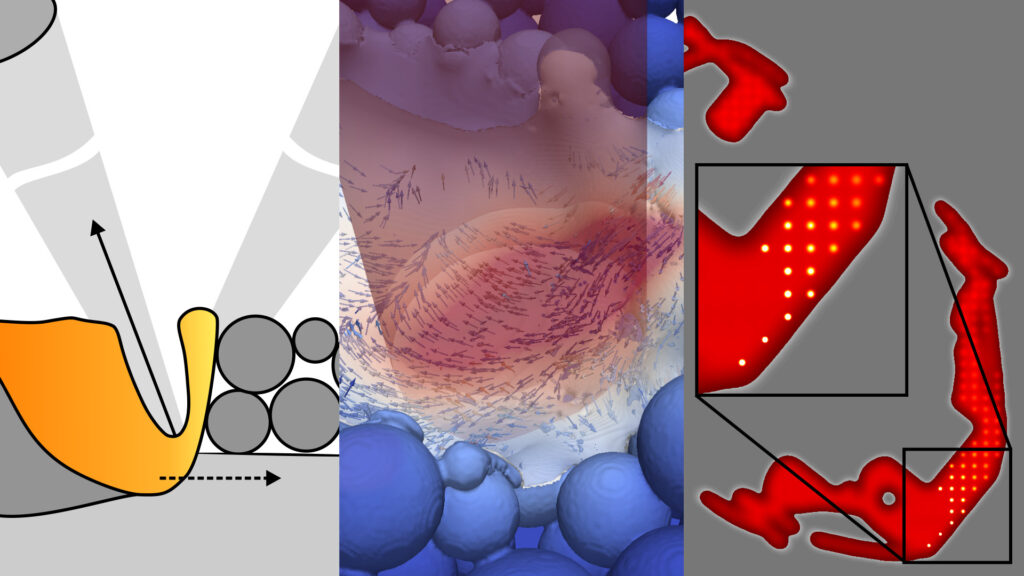
The Numerical Simulation research group focuses on fundamental and application-oriented research in additive manufacturing, with a particular emphasis on Electron Beam Powder Bed Fusion (PBF-EB). The group’s work makes a visible international contribution to the advancement of this technology and is positioned among the leading research efforts worldwide in this field. Central to the research is the development of physically sound simulation approaches that enable a deep understanding of the highly dynamic phenomena occurring during the manufacturing process and open new pathways for targeted process and materials design.
Purely experimental approaches in additive manufacturing quickly encounter fundamental limitations. Key process quantities such as local temperature fields, highly time-resolved thermal cycles, or solidification conditions are only accessible to a limited extent or not directly measurable at all. At the same time, systematic experimental parameter studies are often associated with considerable effort and cost. Against this background, numerical simulation constitutes the primary scientific instrument of the research group, providing access to critical process mechanisms with high spatial and temporal resolution.
The group develops and extends proprietary simulation models and methodological tools that go beyond established standard approaches and actively contribute to the advancement of simulation technology in additive manufacturing. These models enable the quantitative prediction of thermal fields, process dynamics, and microstructural evolution as a function of beam guidance, scan strategy, component geometry, and material properties. In this way, complex interactions within the PBF-EB process become systematically accessible, allowing novel process strategies to be designed and evaluated virtually prior to experimental implementation.
A core principle of the research is the tight coupling of simulation and experiment. Experimental observations are used to validate and parameterize the numerical models, while simulation-based insights directly inform new experimental questions, measurement concepts, and process variants. This reciprocal interaction enables highly targeted experimental investigations and significantly accelerates the generation of scientific insight beyond purely empirical approaches.
Furthermore, numerical simulation provides a key link to alloy development. Detailed analyses of temperature–time histories, cooling rates, and thermal cycling yield essential information on solidification conditions and microstructural evolution. On this basis, alloys can be specifically adapted to the boundary conditions of additive manufacturing processes, and new, material-specific process windows can be established. In this way, the research group contributes not only to process development but also to the materials-driven advancement of additive manufacturing technologies.
- , , :
High-throughput numerical exploration of preheating and sintering in electron beam powder bed fusion
In: Thermal Science and Engineering Progress 69 (2026), Article No.: 104405
ISSN: 2451-9057
DOI: 10.1016/j.tsep.2025.104405 - , , , :
Processing Strategies for Electron Beam Based Powder Bed Fusion
In: Dietmar Drummer, Michael Schmidt (ed.): Progress in Powder Based Additive Manufacturing, Springer Nature, 2025, p. 127-148 (Springer Tracts in Additive Manufacturing, Vol.Part F386)
DOI: 10.1007/978-3-031-78350-0_7 - , , , , :
Introduction to Powder and Beam Based Additive Manufacturing
In: Progress in Powder Based Additive Manufacturing, Cham: Springer, 2025, p. 1-11 (Springer Tracts in Additive Manufacturing, Vol.Part F386)
ISBN: 9783031783494
DOI: 10.1007/978-3-031-78350-0_1 - , , , , , :
Spot melting sequences for complex geometries in electron beam powder bed fusion
In: Progress in Additive Manufacturing (2025)
ISSN: 2363-9512
DOI: 10.1007/s40964-025-01251-w - , , , , :
Spot Melting Strategy for Contour Melting in Electron Beam Powder Bed Fusion
In: Journal of Manufacturing and Materials Processing 9 (2025), p. 303
ISSN: 2504-4494 - , , , :
Simulation-driven development of in-situ alloying Cu-25Cr by electron beam powder bed fusion
In: Additive Manufacturing 109 (2025), Article No.: 104874
ISSN: 2214-7810
DOI: 10.1016/j.addma.2025.104874 - , , , , , :
Mesoscopic Modeling and Simulation of Properties of Additively Manufactured Metallic Parts
In: Dietmar Drummer, Michael Schmidt (ed.): Progress in Powder Based Additive Manufacturing, Springer Nature, 2025, p. 309-330 (Springer Tracts in Additive Manufacturing, Vol.Part F386)
DOI: 10.1007/978-3-031-78350-0_15 - , , , :
A new approach of preheating and powder sintering in electron beam powder bed fusion
In: International Journal of Advanced Manufacturing Technology (2024)
ISSN: 0268-3768
DOI: 10.1007/s00170-024-13966-1 - , , :
Correction to: A Scan Strategy Based Compensation of Cumulative Heating Effects in Electron Beam Powder Bed Fusion (Progress in Additive Manufacturing, (2024), 10.1007/s40964-024-00807-6)
In: Progress in Additive Manufacturing (2024)
ISSN: 2363-9512
DOI: 10.1007/s40964-024-00841-4 - , , :
A Scan Strategy Based Compensation of Cumulative Heating Effects in Electron Beam Powder Bed Fusion
In: Progress in Additive Manufacturing (2024)
ISSN: 2363-9512
DOI: 10.1007/s40964-024-00807-6 - , , , , , , , :
Experimental Validation of Property Models and Databases for Computational Superalloy Design
In: Advanced Engineering Materials (2024)
ISSN: 1438-1656
DOI: 10.1002/adem.202401051 - , , , , , , :
Accelerating Alloy Development for Additive Manufacturing
15th International Symposium on Superalloys, ISS 2024 (Pennsylvania, PA, 8. September 2024 - 12. September 2024)
In: Jonathan Cormier, Ian Edmonds, Stephane Forsik, Paraskevas Kontis, Corey O’Connell, Timothy Smith, Akane Suzuki, Sammy Tin, Jian Zhang (ed.): Minerals, Metals and Materials Series 2024
DOI: 10.1007/978-3-031-63937-1_11 - , , , :
Numerical Microstructure Prediction for Lattice Structures Manufactured by Electron Beam Powder Bed Fusion
In: Crystals 14 (2024), Article No.: 149
ISSN: 2073-4352
DOI: 10.3390/cryst14020149 - , , :
Graph-based spot melting sequence for electron beam powder bed fusion
In: Additive Manufacturing 91 (2024), Article No.: 104321
ISSN: 2214-7810
DOI: 10.1016/j.addma.2024.104321 - , , , , , :
In-situ electron beam characterization for electron beam powder bed fusion
In: Additive Manufacturing 96 (2024), Article No.: 104567
ISSN: 2214-7810
DOI: 10.1016/j.addma.2024.104567 - , , , , :
Extracting powder bed features via electron optical images during electron beam powder bed fusion
In: Additive Manufacturing Letters 10 (2024), Article No.: 100220
ISSN: 2772-3690
DOI: 10.1016/j.addlet.2024.100220 - , , :
Progress in electron beam additive manufacturing
In: Progress in Additive Manufacturing (2024)
ISSN: 2363-9512
DOI: 10.1007/s40964-024-00679-w - , , , :
A CALPHAD-Informed Enthalpy Method for Multicomponent Alloy Systems with Phase Transitions
In: Modelling 5 (2024), p. 367-391
ISSN: 2673-3951
DOI: 10.3390/modelling5010020 - , , :
In situ build surface topography determination in electron beam powder bed fusion
In: Progress in Additive Manufacturing (2024)
ISSN: 2363-9512
DOI: 10.1007/s40964-024-00621-0 - , , , , , , :
Design and Characterization of a Novel NiAl–(Cr,Mo) Eutectic Alloy
In: Advanced Engineering Materials (2024)
ISSN: 1438-1656
DOI: 10.1002/adem.202302079 - , , :
A thermo-mechanical model for hot cracking susceptibility in electron beam powder bed fusion of Ni-base superalloys
In: Materials & Design 237 (2024), Article No.: 112528
ISSN: 0264-1275
DOI: 10.1016/j.matdes.2023.112528 - :
Numerische Entwicklung von Superlegierungen für den Guss und die Additive Fertigung (Dissertation, 2024) - , , , :
Effect of scanning strategies on grain structure and texture of additively manufactured lattice struts: A numerical exploration
In: Advanced Engineering Materials (2024)
ISSN: 1438-1656
DOI: 10.1002/adem.202400661 - , , :
Comprehensive numerical investigation of laser powder bed fusion process conditions for bulk metallic glasses
In: Additive Manufacturing 81 (2024), Article No.: 104026
ISSN: 2214-7810
DOI: 10.1016/j.addma.2024.104026 - :
Modeling and Simulation of Bulk Metallic Glass Crystallization During Laser Powder Bed Fusion (Dissertation, 2024)
DOI: 10.25593/open-fau-715 - , , , , , , , , , :
Evaluation of Additively-Manufactured Internal Geometrical Features Using X-ray-Computed Tomography
In: Journal of Manufacturing and Materials Processing (2023)
ISSN: 2504-4494
DOI: 10.3390/jmmp7030095 - , , , :
High-Throughput Numerical Investigation of Process Parameter-Melt Pool Relationships in Electron Beam Powder Bed Fusion
In: Modelling 4 (2023), p. 336-350
ISSN: 2673-3951
DOI: 10.3390/modelling4030019 - , , :
A return time compensation scheme for complex geometries in electron beam powder bed fusion
In: Additive Manufacturing 76 (2023), p. 103767
ISSN: 2214-7810
DOI: 10.1016/j.addma.2023.103767 - , , , , :
Alternative Approach to Modeling of Nucleation and Remelting in Powder Bed Fusion Additive Manufacturing
In: Advanced Engineering Materials (2023)
ISSN: 1438-1656
DOI: 10.1002/adem.202201682 - , , , , , , , , , , :
Additive manufacturing of cellular structures: Multiscale simulation and optimization
In: Journal of Manufacturing Processes 95 (2023), p. 275-290
ISSN: 1526-6125
DOI: 10.1016/j.jmapro.2023.03.071 - , , , , , , , , , , :
Geometrical Influence on Material Properties for Ti6Al4V Parts in Powder Bed Fusion
In: Journal of Manufacturing and Materials Processing 7 (2023), p. 82
ISSN: 2504-4494
DOI: 10.3390/jmmp7030082 - , , , :
A Ray Tracing Model for Electron Optical Imaging in Electron Beam Powder Bed Fusion
In: Journal of Manufacturing and Materials Processing 7 (2023), Article No.: 87
ISSN: 2504-4494
DOI: 10.3390/jmmp7030087 - , , :
Volume of fluid based modeling of thermocapillary flow applied to a free surface lattice Boltzmann method
In: Journal of Computational Physics 492 (2023), Article No.: 112441
ISSN: 0021-9991
DOI: 10.1016/j.jcp.2023.112441 - , , , , :
Phase-Field Study of the History-Effect of Remelted Microstructures on Nucleation During Additive Manufacturing of Ni-Based Superalloys
In: Metallurgical and Materials Transactions A-Physical Metallurgy and Materials Science (2023)
ISSN: 1073-5623
DOI: 10.1007/s11661-023-07004-0 - , , :
A Thermo-Mechanical Model for Hot Cracking Susceptibility in Electron Beam Powder Bed Fusion of Ni-Base Superalloys
In: Materials & Design 237 (2023), p. 112528
ISSN: 0264-1275
DOI: 10.1016/j.matdes.2023.112528 - , , , , , , :
Revealing bulk metallic glass crystallization kinetics during laser powder bed fusion by a combination of experimental and numerical methods
In: Journal of Non-Crystalline Solids 619 (2023), Article No.: 122532
ISSN: 0022-3093
DOI: 10.1016/j.jnoncrysol.2023.122532 - , , , , :
SAMPLE3D: A versatile numerical tool for investigating texture and grain structure of materials processed by PBF processes
IVth International Conference on Simulation for Additive Manufacturing (Sim-AM 2023) (München, 26. July 2023 - 28. July 2023)
DOI: 10.23967/c.simam.2023.006 - , , , :
Basic Mechanism of Surface Topography Evolution in Electron Beam Based Additive Manufacturing
In: Materials 15 (2022), Article No.: 4754
ISSN: 1996-1944
DOI: 10.3390/ma15144754 - , , , :
Surface topographies from electron optical images in electron beam powder bed fusion for process monitoring and control
In: Additive Manufacturing 60 (2022), Article No.: 103172
ISSN: 2214-7810
DOI: 10.1016/j.addma.2022.103172 - , , :
Predictive simulation of bulk metallic glass crystallization during laser powder bed fusion
In: Additive Manufacturing 59 (2022), Article No.: 103121
ISSN: 2214-7810
DOI: 10.1016/j.addma.2022.103121 - , , , , , , , :
Evolution of an industrial-grade Zr-based bulk metallic glass during multiple laser beam melting
In: Journal of Non-Crystalline Solids 589 (2022), Article No.: 121649
ISSN: 0022-3093
DOI: 10.1016/j.jnoncrysol.2022.121649 - , , , , , , , , , :
Numerical Design of CoNi-Base Superalloys With Improved Casting Structure
In: Metallurgical and Materials Transactions A-Physical Metallurgy and Materials Science (2022)
ISSN: 1073-5623
DOI: 10.1007/s11661-022-06870-4 - , , , :
A multivariate meltpool stability criterion for fabrication of complex geometries in electron beam powder bed fusion
In: Additive Manufacturing 45 (2021), Article No.: 102051
ISSN: 2214-7810
DOI: 10.1016/j.addma.2021.102051 - , , , , , :
A Novel Approach to Predict the Process-Induced Mechanical Behavior of Additively Manufactured Materials
In: Journal of Materials Engineering and Performance (2021)
ISSN: 1059-9495
DOI: 10.1007/s11665-021-05725-0 - , , , :
Multi-material model for the simulation of powder bed fusion additive manufacturing
In: Computational Materials Science 194 (2021)
ISSN: 0927-0256
DOI: 10.1016/j.commatsci.2021.110415 - , , , , :
New grain formation mechanisms during powder bed fusion
In: Materials 14 (2021), Article No.: 3324
ISSN: 1996-1944
DOI: 10.3390/ma14123324 - , , , :
Numerical Alloy Development for Additive Manufacturing towards Reduced Cracking Susceptibility
In: Crystals 11 (2021)
ISSN: 2073-4352
DOI: 10.3390/cryst11080902 - , , , , , , , , :
How electron beam melting tailors the Al-sensitive microstructure and mechanical response of a novel process-adapted γ-TiAl based alloy
In: Materials & Design 212 (2021), Article No.: 110187
ISSN: 0264-1275
DOI: 10.1016/j.matdes.2021.110187 - , , , :
Modeling laser beam absorption of metal alloys at high temperatures for selective laser melting
In: Advanced Engineering Materials 23 (2021), Article No.: 2100137
ISSN: 1438-1656
DOI: 10.1002/adem.202100137 - , , , , , :
Isothermal crystallization kinetics of an industrial-grade Zr-based bulk metallic glass
In: Journal of Non-Crystalline Solids 573 (2021), Article No.: 121145
ISSN: 0022-3093
DOI: 10.1016/j.jnoncrysol.2021.121145
Funding source: ERC Advanced Grant
Project leader:
Prof. Dr.-Ing. habil. Carolin Körner
Head
Contact
Additive manufacturing (AM), a bottom-up approach that ‘adds’ successive layers to produce a component, has reduced the cost, time and materials’ waste of aerospace parts production while enhancing the design space and properties. Powder bed fusion-electron beam (PBF-EB) AM begins with metal powders that are melted to form the layers. The challenge is to control the AM process to ensure the desired local materials properties. The EU-funded AMELI project will integrate PBF-EB AM with powerful scann…
Funding source: Bundesministerium für Wirtschaft und Klimaschutz (BMWK)
Project leader:
Prof. Dr.-Ing. habil. Carolin Körner
Head
Contact
Funding source: DFG / Sonderforschungsbereich / Transregio (SFB / TRR)
Project leader:

Dr.-Ing. Matthias Markl
Research associates
Contact
A new numerical tool will be explored that supports the experimental alloy developer in defining new compositions with potential for high strength. Starting with a composition space that is defined by the developer based on his metallurgical experience and his design goals, the numerical tool will propose the most promising compositions. The research program will on the one hand address open questions regarding the mathematical optimization in this application and on the other hand new models for predicting the relevant material properties.
Funding source: Bundesministerium für Wirtschaft und Energie (BMWE)
Project leader:
Prof. Dr.-Ing. habil. Carolin Körner
Head
Contact
Funding source: DFG - Sonderforschungsbereiche
Project leader: ,
Prof. Dr.-Ing. habil. Carolin Körner
Head
Contact
Based on the gained knowledge of projects B4 and C5, the aim of this project is to account for the influence of part borders on the resulting material/part-mesostructure for powder- and beam-based additive manufacturing technologies of metals and to model the resulting meso- and macroscopic mechanical properties. The mechanical behavior of these mesostructures and the influence of the inevitable process-based geometrical uncertainties is modelled, verified, quantified and validated especially for cellular grid-based structures.
Funding source: DFG / Sonderforschungsbereich (SFB)
Project leader: ,
Prof. Dr.-Ing. habil. Carolin Körner
Head
Contact
Dr.-Ing. Matthias Markl
Research associates
Contact
The aim of this project is to facilitate additive manufacturing of bulk metallic components by selective laser melting based on predictive numerical simulations. There should be developed suitable process strategies to ensure the amorphous material state preferably without aging effects in the bulk as well as for complex geometries. Therefore, clear statements using the numerical simulation has to be made exceeding the temperature field and the material consolidation during manufacturing towards the solidification behavior, aging and finally crystallization.
Funding source: DFG-Einzelförderung / Sachbeihilfe (EIN-SBH)
Project leader:
Prof. Dr.-Ing. habil. Carolin Körner
Head
Contact
Funding source: DFG-Einzelförderung / Sachbeihilfe (EIN-SBH)
Project leader:
Dr.-Ing. Matthias Markl
Research associates
Contact
Beam-based additive manufacturing (AM) of metals in a powder bed not only offers the opportunity to build complex, custom-made components of high-performance materials, but also to adjust the local material properties by proficient processing. The variation of solidification conditions enables the modification of microstructure length scales. Additionally, latest research results indicate, that also the texture of the components is adjustable during manufacturing. Therefore, entirely new perspectives are opened regarding optimization of light weight components, because not only the topology, but also the texture of the material is adjustable to the local loads on the component. In order to comprehend and control the texture evolution, the hydrodynamic non-equilibrium solidification process (grain growth, selection and nucleation) needs to be fundamentally understood. Experimental investigations show that especially the mechanisms of nucleation under the extreme conditions of AM are insufficiently resolved and are not reproduced by classical models.The aim of this proposal is to identify, to fundamentally understand and to physically model the microstructure evolution, especially the nucleation under the special solidification. This model should be implemented in existing software, which is developed at our chair. Modeling and verification are experimentally substantiated basing on additively manufactured samples of IN718. At the end of the project the model should predict the solidification structure, grain structure and texture evolution during beam and powder bed-based AM.The project draws on our software for simulating the consolidation process during beam and powder bed-based AM. The software contains a lattice Boltzmann method to describe the hydro- and thermodynamics during melting and solidification. This method s coupled to a cellular automaton modeling the grain structure evolution during solidification neglecting currently grain nucleation. Our new theoretical ansatz contains besides the temperature gradient and the solidification front velocity for the first time additional information about the texture of the previous layers (orientation, spacing of cells/dendrites, segregation) and the local composition of the melt at the interface to the currently processed layer. It should be investigated, how orientation changes at the solidification front in combination with the present segregations in the rapidly melted material (memory of melt) induce grain nucleation by local undercooling. These findings are mathematically utilized for a grain nucleation model.
Funding source: DFG / Sonderforschungsbereich (SFB)
Project leader:
Prof. Dr.-Ing. habil. Carolin Körner
Head
Contact
The basic mechanisms that are essential in the powder based selective beam melting process are poorly understood. Most of the existing analytical and numerical models describing the process of consolidation in a homogenized image, i.e. individual powder particles are not resolved. This approach is suitable for information on averages, but cannot capture the local influence of the powder, i.e. the powder size distribution, the stochastic effect of the powder bed, the wetting of the powder by the melt and the formation of the melt. The actual selective melting process and thereby acting mechanisms can only be understood on the scale of the powder particles, with the help of numerical simulation on the mesoscopic scale. The aim of this project is to provide a numerical tool for mesoscopic simulation of selective beam melting and to use it to develop innovative process strategies. The mesoscopic scale allows the prediction of defects, surface quality and accuracy of the structure for different materials as a function of material parameters (powder form, bulk density, ...) and the process parameters (beam shape, energy per unit length, speed, ...).
In the first phase, a tool for the 2D simulation of selective electron beam melting was developed and validated with experimental results. The main task was the modeling of the entire build process with its different time scales (pre-heating, melting, applying new powder layer). Among other things, the complex coupling of the beam in the powder bed, radiation losses at the surface, mass and energy loss through evaporation and the deformation of the molten bath by the evaporation pressure is taken into account. The software is now able to simulate assembly processes, taking into account different scanning strategies on many layers. Such process strategies as the remelt strategy and the refill strategy are investigated. The verification of the numerical results is done in close cooperation with subproject B2.
In the second phase, the previous model is transferred to polymers. For this purpose, the absorption of the laser beam in the partially transparent stochastic powder bed and the highly viscous, viscoelastic material behavior must be described. Development and verification of the model is carried out in cooperation with subproject B3. In a further step, a method of 3D simulation of the grain structure in the selective beam melting of metals is implemented, in order to predict the texture of the materials as a function of process strategy.
Funding source: EU - 7. RP / Cooperation / Verbundprojekt (CP)
Project leader:
Prof. Dr.-Ing. habil. Carolin Körner
Head
Contact
The overarching goal of AMAZE is to rapidly produce large defect-free additively-manufactured (AM) metallic components up to 2 metres in size, ideally with close to zero waste, for use in the following high-tech sectors namely: aeronautics, space, automotive, nuclear fusion and tooling.
Four pilot-scale industrial AM factories will be established and enhanced, thereby giving EU manufacturers and end-users a world-dominant position with respect to AM production of high-value metallic parts, by 2016. A further aim is to achieve 50% cost reduction for finished parts, compared to traditional processing.
The project will design, demonstrate and deliver a modular streamlined work-flow at factory level, offering maximum processing flexibility during AM, a major reduction in non-added-value delays, as well as a 50% reduction in shop-floor space compared with conventional factories.
AMAZE will dramatically increase the commercial use of adaptronics, in-situ sensing, process feedback, novel post-processing and clean-rooms in AM, so that (i) overall quality levels are improved, (ii) dimensional accuracy is increased by 25% (iii) build rates are increased by a factor of 10, and (iv) industrial scrap rates are slashed to <5%. Scientifically, the critical links between alloy composition, powder/wire production, additive processing, microstructural evolution, defect formation and the final properties of metallic AM parts will be examined and understood. This knowledge will be used to validate multi-level process models that can predict AM processes, part quality and performance. In order to turn additive manufacturing into a mainstream industrial process, a sharp focus will also be drawn on pre-normative work, standardisation and certification, in collaboration with ISO, ASTM and ECSS. The team comprises 31 partners: 21 from industry, 8 from academia and 2 from intergovernmental agencies. This represent the largest and most ambitious team ever assembled on this topic.
Funding source: EU - 7. RP / Capacities / Forschung für spezielle Gruppen (insbesondere KMU) (SME)
Project leader:
Prof. Dr.-Ing. habil. Carolin Körner
Head
Contact
Electron beam melting additive manufacturing is used to produce successive layers of a part in a powder bed and offers the ability to produce components closest to their final dimensions, with good surface finish. At this time the process is faster than any other technique of comparable quality, however the parts are not produced at sufficient rate to make them economically viable for any but very high value specific applications. One key output of the project will be the knowledge surrounding the use of the high powder electron beam gun, including the process control, and modeled and validated understanding of beam-powder bed interaction. The target objectives is the transfer of the 2D model to a 3D model and its parallel implementation. The outcome of the simulation will be compared with real experimental data and therefore the model parameters are adjusted in such a way that the resulting numerical melt pool sizes correspond to the experimental ones.
Funding source: Sonstige EU-Programme (z. B. RFCS, DG Health, IMI, Artemis)
Project leader:
Prof. Dr.-Ing. habil. Carolin Körner
Head
Contact
Funding source: DFG-Einzelförderung / Sachbeihilfe (EIN-SBH)
Project leader:
Prof. Dr.-Ing. habil. Carolin Körner
Head
Contact
Geschäumte Materialien stellen aufgrund ihrer zellularen Struktur eine interessante Materialklasse mit attraktiven Eigenschaften dar. Unabhängig vom Material ist die Schaumbildung im Allgemeinen wenig verstanden und die Schaumherstellung basiert im Wesentlichen auf dem Trial-and-Error-Prinzip. Die numerische Simulation eröffnet hier neue Wege, grundlegende Phänomene bei der Schaumbildung zu er-forschen und die daraus abgeleiteten Erkenntnisse praktisch umzusetzen. Basis für das beantragte Proj…
Project leader: ,
Prof. Dr.-Ing. habil. Carolin Körner
Head
Contact
In the last few years methods, cellular automata (CA) became increasingly popular to simulate the physical phenomena that have to be considered when developing and manufacturing new materials. Among these phenomena are the formation of grain structures or dendrites during solidification. A special CA called Lattice Gas or Lattice Boltzmann Method (LBM) is perfectly suited for modeling flows in complex and time- dependent geometries as they are encountered in the context of metal foams or of composite…
Funding source: DFG-Einzelförderung / Sachbeihilfe (EIN-SBH)
Project leader:
Prof. Dr.-Ing. habil. Carolin Körner
Head